Table of contents
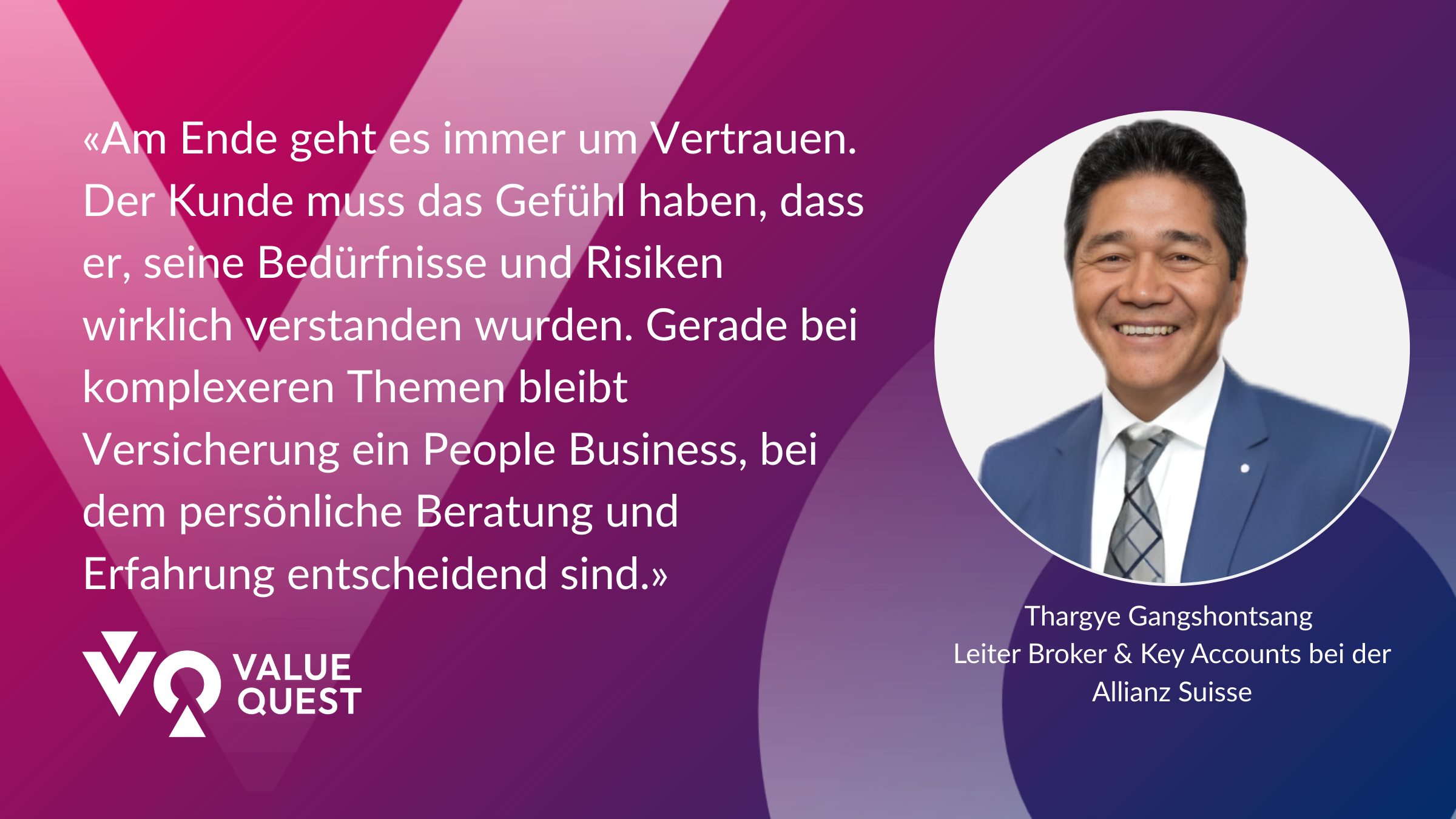
Our co-managing director Kathrin Neumüller interviewed Thargye Gangshontsang, Head of Broker & Key Accounts at Allianz Suisse. The interview focuses on the role of insurance brokers in the Swiss market, cooperation between insurers and brokers, and why structured feedback is important for both sides. Brokers, and thus the broker channel, are an important customer interface and play a very important role in Allianz Suisse's multi-channel strategy, which takes into account different approaches for different customer needs.
Role of brokers in the Swiss insurance market
Kathrin Neumüller: What exactly do insurance brokers do, and what role do they play in the Swiss insurance market today?
Thargye Gangshontsang: Brokers, i.e., independent insurance intermediaries, play an important role in the Swiss insurance industry. Their share is growing year on year, particularly in corporate business. But they can also be relevant in the retail sector, depending on what a broker specializes in.
In terms of volume, our own sales are stronger than the broker channel. If I look at the figures for Allianz Suisse, for example, slightly more than half of the premium volume in corporate business is generated through the broker channel, with the other half coming from the general agency channel, i.e., our own sales.
Brokers are legally obliged to act in the interests of the policyholder. They examine the market and are required to find and recommend the best possible solution for the customer.
Kathrin Neumüller: Does that mean they are always neutral?
Thargye Gangshontsang: The value proposition of a broker is to find the best and most suitable solution on the market for the end customer and to recommend it accordingly.
Why customers choose a broker
Kathrin Neumüller: You have already mentioned the advantages for end customers. Why do companies or private customers choose a broker rather than contacting an insurance company directly?
Thargye Gangshontsang: There can be various reasons for this. On the one hand, an entrepreneur or customer may simply say: I don't want to deal with this issue myself, I'd rather bring in a professional who can advise me and recommend a suitable solution.
The broker has access to the entire market and is not limited to a single company. This allows them to compare different offers and suggest the best solution for the customer.
Corporate customers often say: I don't want to manage my insurance portfolio myself; I'd rather hand it over to someone who has the professionalism and expertise to do so. Customers then benefit directly from this service.
Kathrin Neumüller: My hypothesis would be that this is particularly relevant for corporate customers, whereas private customers tend to have standard insurance policies.
Thargye Gangshontsang: You have to differentiate. In retail, it's often a matter of standardized mass solutions. Processes need to be as simple as possible, and self-service solutions play a major role.
As soon as situations become more complex, more expertise and often a network are required. Support is then useful so that the customer does not have to work through everything themselves.
Who is behind the Broker Panel Switzerland?
The Broker Panel Switzerland 2025 is conducted by the market research company ValueQuest in close cooperation with the ten leading Swiss insurance companies: Allianz, AXA, Asga Pensionskasse, Generali, Helsana, Helvetia, die Mobiliar, Profond, Swiss Life, and Zurich Insurance. We would like to take this opportunity to express our sincere thanks for their cooperation. The Broker Panel Switzerland is headed by Sabrina Karthe.
We would also like to thank our partner LaBella Consulting for their cooperation in the implementation.
Are you a broker and would like to take part? Then register now directly at www.brokerpanel.ch.
When is it advisable to use a broker, and what role does trust play?
Kathrin Neumüller: Are there situations in which a broker is more or less useful, or is it always useful?
Thargye Gangshontsang: That depends very much on the individual situation. Ultimately, it is up to the customer to decide who they want to seek advice from. Insurance is not usually the customer's main concern, but it is very important because it involves risk coverage, asset protection, and retirement planning, and trust plays a crucial role in this.
Trust is crucial. Where do I feel well advised, where do I feel safe and secure? This applies to private customers as well as corporate customers. The insurance industry is a people business.
However, experience shows that corporate insurance is significantly more complex. In addition to mandatory issues such as accident insurance and pension funds, there is also the responsibility of the employer towards its employees.
What insurers expect from brokers
Kathrin Neumüller: As an insurance company, what specific expectations do you have of professional brokers?
Thargye Gangshontsang: Professionalism, technical expertise, methodological competence, and a good network are key.
This starts with tenders. These must be conducted at a level that leads to good solutions and does not result in constant inquiries or quality defects.
This applies not only to the placement process, but also during the contract phase. Once the contract is in place and the broker is needed, the relevant expertise is required.
We operate within a triangular relationship between policyholders, brokers, and insurers. All parties involved must have the necessary skills to ensure that our mutual customers receive the best possible service tailored to their needs.
Common misunderstandings between brokers and insurers
Kathrin Neumüller: What misunderstandings arise in everyday life between brokers and insurance companies?
Thargye Gangshontsang: It often comes down to conflicts of interest, for example, when it comes to the necessary insurance solution or a risk-adjusted price. The broker represents the client's interests and might say, for example, that the premium is too high. The insurer, on the other hand, needs this premium to remain profitable. This naturally creates tension.
Misunderstandings also arise when mistakes are made. This can happen on either side. It is important that the mutual customer does not suffer as a result.
If, for example, coverage is incorrectly advertised, responsibility cannot simply be passed on. Such situations must be clarified and corrected as quickly as possible.
Digitalization in the collaboration between insurers and brokers
Kathrin Neumüller: How has digitalization changed the way insurers and brokers work together in recent years?
Thargye Gangshontsang: A lot has happened over the past ten years. At the same time, we are not yet where we would like to be. We don't yet have truly smooth, digital processes in everyday life everywhere.
Broker portals already work well in mass business today. There, a broker can, for example, process offers and applications largely end-to-end.
In corporate business, however, there is still room for improvement and potential for further development. There are industry platforms (EcoHub) and IT providers (e.g., Sobrado) that promote cooperation between brokers and insurers and are very valuable for digitalization in the brokerage business, but we still have room for optimization, and standardization plays an important role in this. Without standardization, digitalization can only work to a limited extent.
The future of brokers: automation and personal advice
Kathrin Neumüller: Will brokers become more important or less important in the future?
Thargye Gangshontsang: In corporate business, I am convinced that brokers will continue to play an important role. How this will develop in private customer business remains to be seen.
Kathrin Neumüller: Which tasks will be automated, and where will consulting remain central?
Thargye Gangshontsang: The insurance business remains a people business, especially when it comes to complex issues.
Let's take a simple example: if you're going on vacation for two weeks, you can take out travel insurance relatively easily. You won't do a lot of analysis. You just want to make sure that you'll be brought home in an emergency or that cancellation costs are covered. This is typical mass business and will increasingly be done digitally.
As risks become more complex, advice remains crucial. The future lies in a good mix of digitalization and personal support.
Digital processes can simplify many things, such as contract changes or data collection. AI will also help eliminate the need to ask certain questions because the information is already available. This facilitates interaction between customers, brokers, and insurers.
How SMEs can find the right broker
Kathrin Neumüller: What should a corporate client, such as an SME, look for when choosing a broker, and how do you find the right one?
Thargye Gangshontsang: When I start an SME, this question arises very early on. Even in the start-up phase, I need someone to explain to me which risks must be insured and what I need to pay attention to.
A start-up consultant can often provide initial advice. However, you can also gather information through industry contacts or networks, or have several brokers introduced to you and compare them.
Experience in your own industry is particularly important. If a broker has never worked with a company in my industry before, they first have to familiarize themselves with all the specific risks involved. If they already have similar clients in their portfolio, they immediately bring more understanding and added value to the table.
Why structured feedback is crucial
Kathrin Neumüller: How important is systematic feedback for you in order to measurably improve your performance?
Thargye Gangshontsang: Any fact-based feedback is a big advantage. However, the challenge with the broker panel is the level of detail in the statements.
We receive reviews ranging from good to bad, but often without specific reasons. For example, if someone says that the support is not good, that is a warning sign for us. But without knowing why, we cannot yet take targeted action.
The more specific we are about why a rating is poor, the sooner we can make improvements.
Kathrin Neumüller: Did you then actively approach brokers to inquire?
Thargye Gangshontsang: Yes. We have also conducted additional surveys and contacted individual brokers directly to obtain more details. The results were mixed. Some participated, others less so, because such additional surveys naturally take time.
It's always a balancing act. On the one hand, the surveys shouldn't be too long, but on the other hand, they need to be detailed enough to allow concrete improvements to be identified.
What exactly has changed in the Broker Panel
Kathrin Neumüller: What specifically did you learn from the broker panel at Allianz Suisse that you would not otherwise see in your day-to-day business?
Thargye Gangshontsang: In recent years, we have focused strongly on service quality and customer orientation. Our goal is to continue moving forward.
The results show us a direction, even if they are not always very specific. That is why we have decided to work on the areas that we can directly influence: professional and social competence, better accessibility, faster response times, and higher delivery capacity.
If these factors improve, perceptions will automatically improve as well. The Broker Panel has once again confirmed and reinforced this approach.
Kathrin Neumüller: What does that mean for participation in the broker panel?
Thargye Gangshontsang: The more feedback we receive and the more specific it is, the more we can do with it. In the end, everyone benefits because cooperation improves.
Post published on March 2, 2026
About Karthe Sabrina

Sabrina is Managing Partner and Data Analyst at ValueQuest. She co-manages the Swiss Broker Panel in collaboration with Switzerland's top 10 insurance companies. She studied mathematics at Mittweida University of Applied Sciences.
Inspired? Then share this post via your favorite platform.
Other articles that might interest you ...

AI in the Swiss Insurance Market: What Insurers Can Learn from the Results
October 1, 2026
Reading time: 4 min
Artificial intelligence is not universally accepted in the Swiss insurance market. As a study by ValueQuest shows, customers’ openness to AI depends heavily on how it is used.

AI in the Swiss Insurance Market: Between Acceptance and Skepticism
September 28, 2026
Reading time: 5 min
For many Swiss people, artificial intelligence has become an integral part of everyday life. However, the situation is different when it comes to insurance companies.
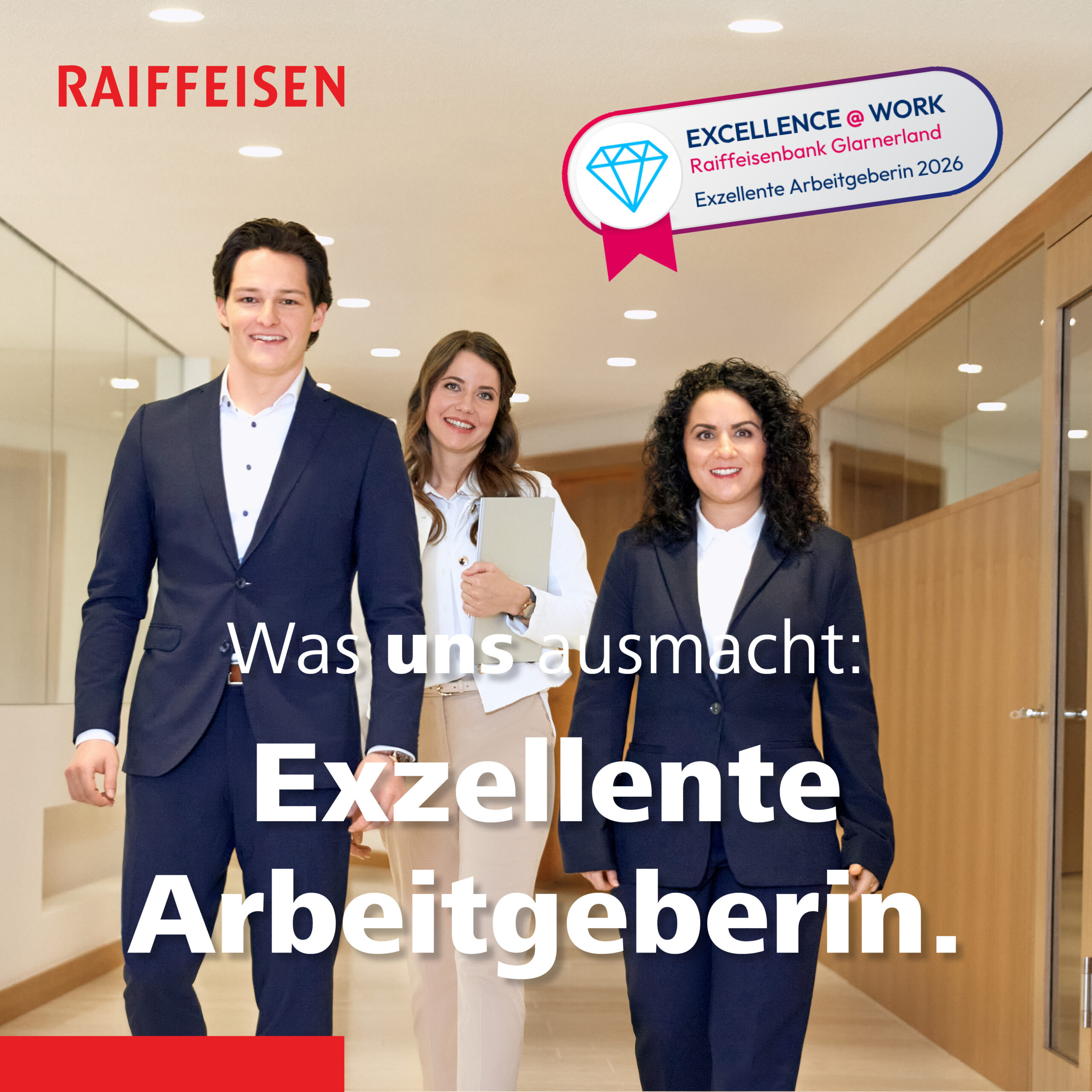
Top Employer: Raiffeisenbank Glarnerland Impresses with Strong Leadership
September 21, 2026
Reading time: 2 min
ValueQuest recently had the honor of presenting the “Excellence@Work Award” to Raiffeisenbank Glarnerland. We extend our heartfelt congratulations.
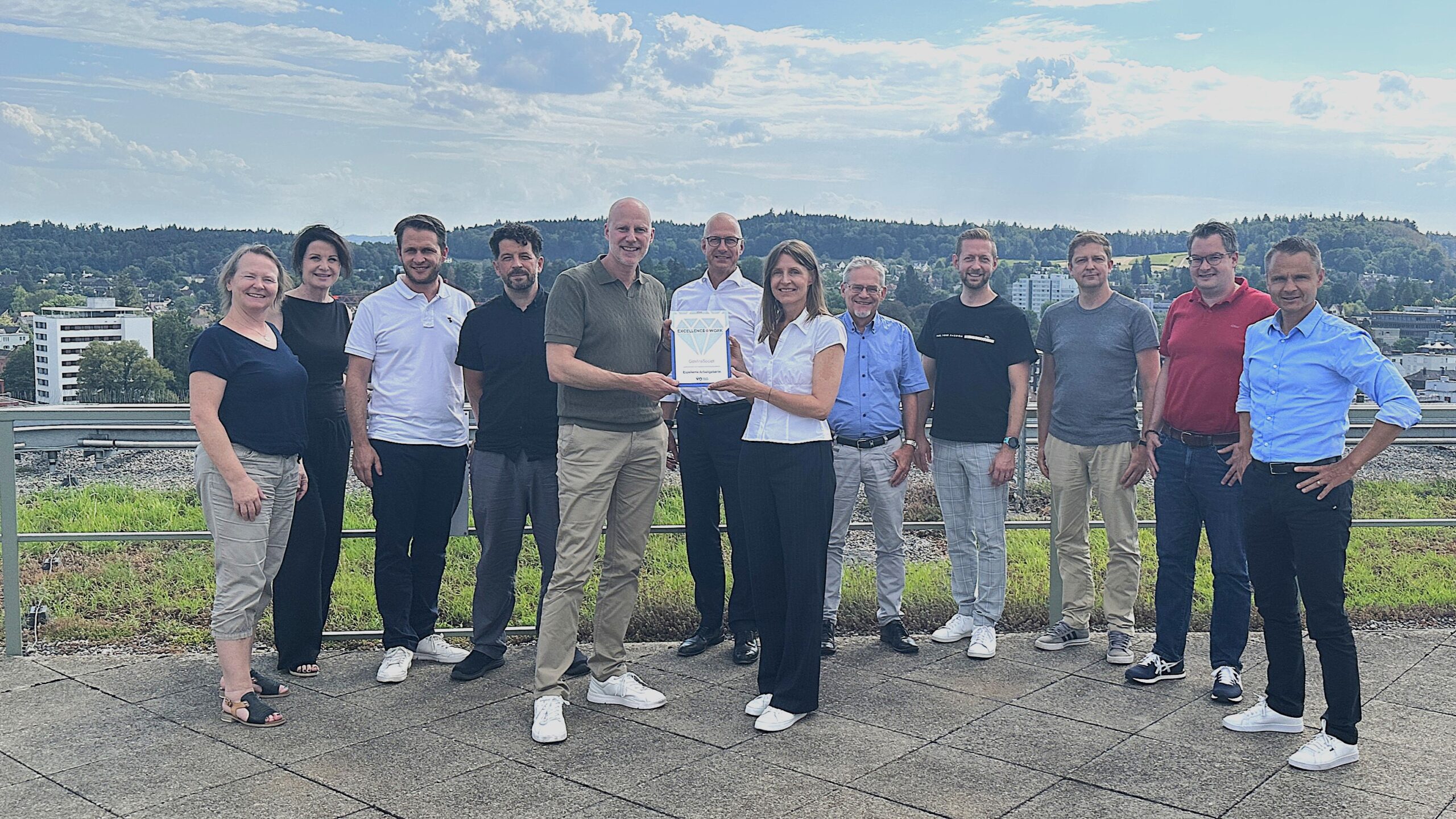
Top Swiss Employers: GastroSocial
September 9, 2026
Reading time: 3 min
GastroSocial has received the 2026 Excellence@Work Award from ValueQuest. With a response rate of 96 percent, a motivation score of 84, and 87 percent of employees serving as brand ambassadors, the company demonstrates a strong employer culture.

Employee Survey: Raiffeisenbank Möhlin Achieves Excellent Results
August 31, 2026
Reading time: 3 min
Raiffeisenbank Möhlin is one of Switzerland's top employers and is receiving our Excellence@Work Award in recognition of this achievement. Congratulations!

Employee Surveys in Switzerland: Find Providers & Tools
August 30, 2026
Reading time: 6 min
Employee Survey in Switzerland: How Do You Find the Right Employee Survey Provider? What Really Matters When It Comes to Anonymity, Tools, Questionnaires, and Analysis.

360-Degree Feedback Questionnaire: Sample, Template, and Sample Questions
August 21, 2026
Reading time: 7 min
Table of Contents A 360-degree feedback process is only as good as its questionnaire. The questionnaire is at the heart of the entire process. It determines whether...
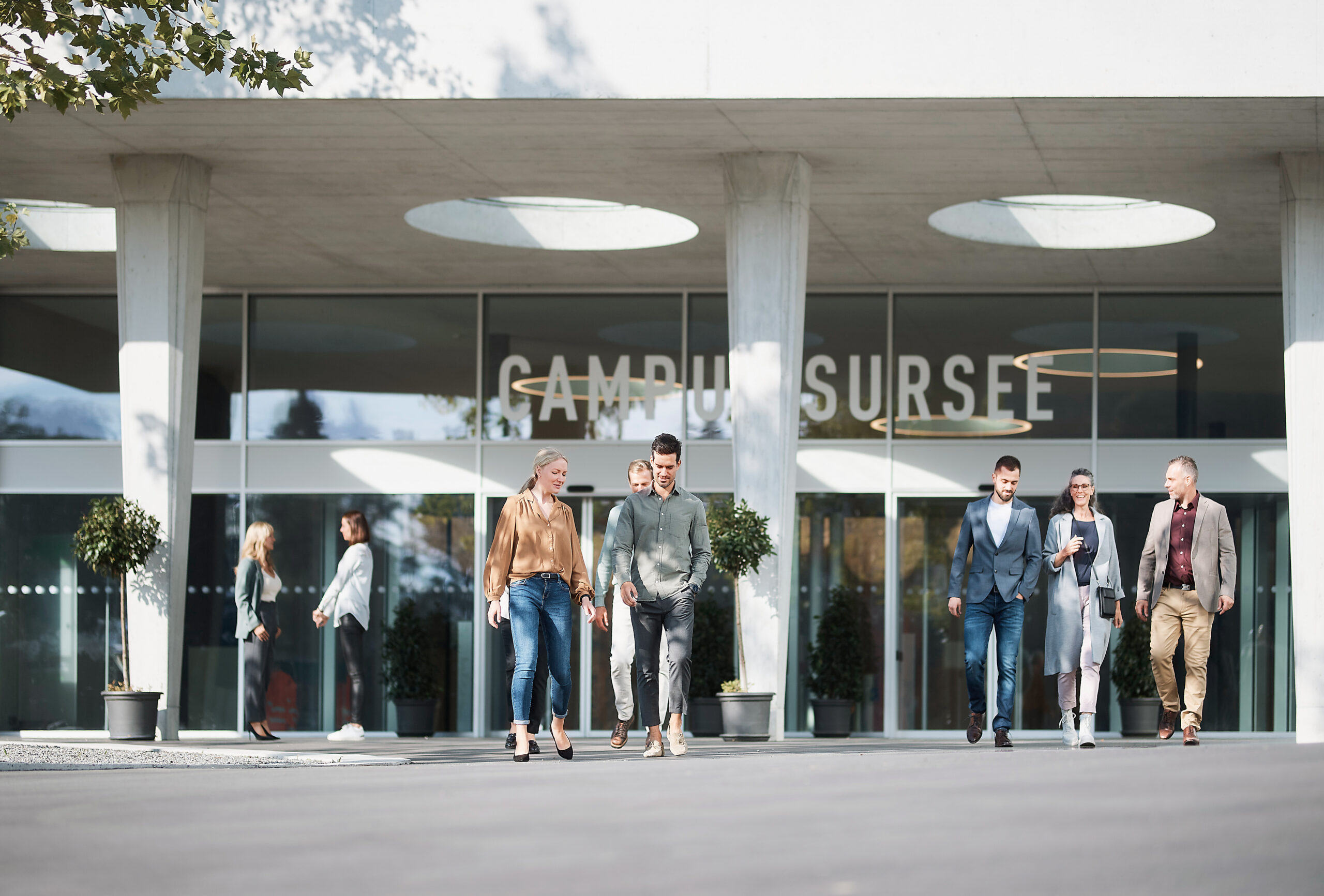
Employee Survey: The CAMPUS SURSEE Foundation Is Among Switzerland's Best Employers
August 5, 2026
Reading time: 2 min
ValueQuest honors particularly attractive employers in Switzerland with the Excellence@Work Award. We recently had the pleasure of presenting the award to the CAMPUS SURSEE Foundation.
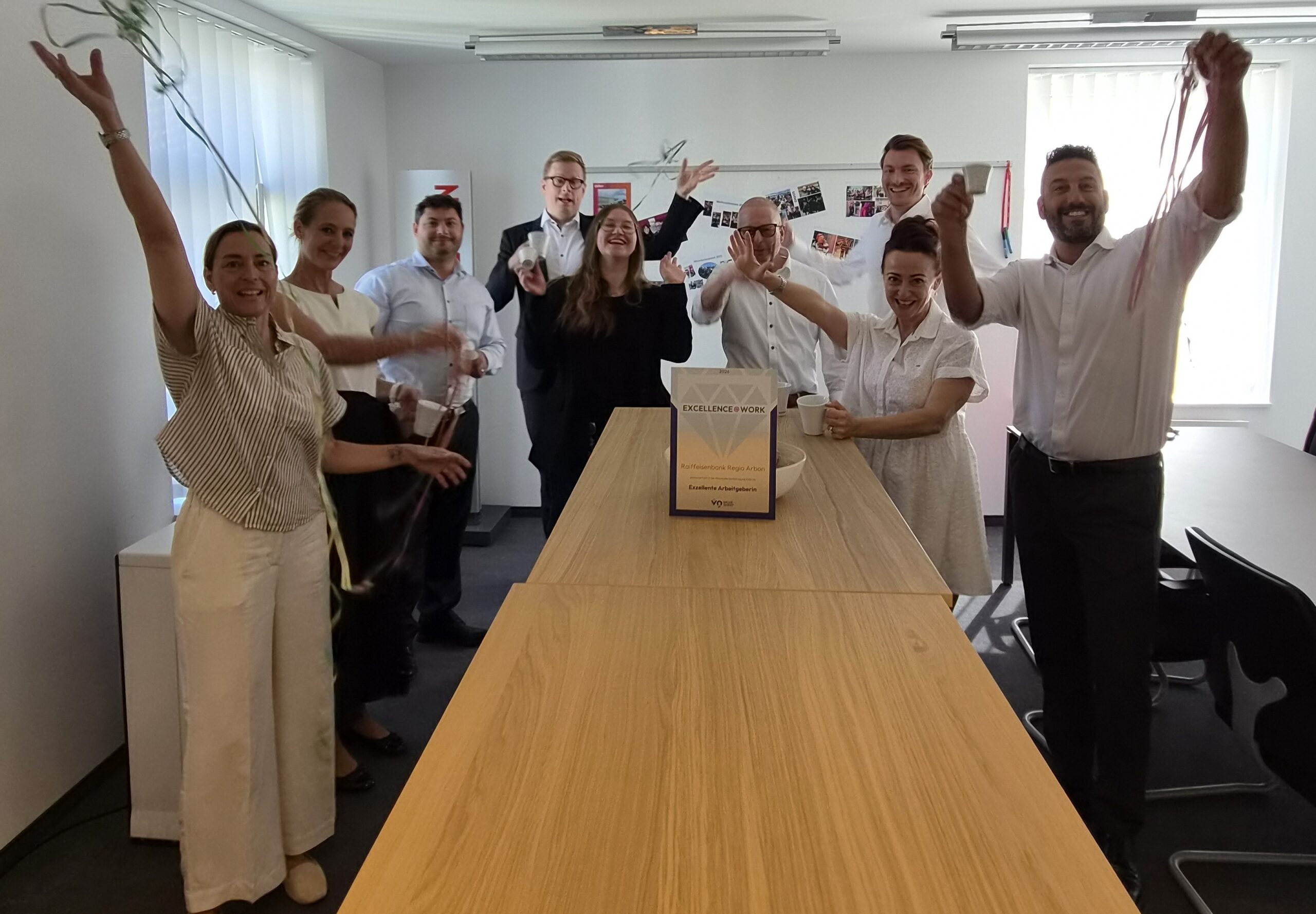
Raiffeisenbank Regio Arbon, a Top Employer: Personal Responsibility as Part of a Strong Corporate Culture
July 7, 2026
Reading time: 2 min
ValueQuest honors particularly attractive employers in Switzerland with the Excellence@Work Award. We recently had the pleasure of presenting the award to Raiffeisenbank Regio Arbon.