
Table of contents
Companies face the challenge not only of attracting the best employees, but also of retaining them over the long term. High employee satisfaction and retention are not just “nice-to-haves,” but critical factors for sustainable business success. But how can you reliably and efficiently gauge the mood of your workforce? How can you determine whether your employees truly support your company?
This is where the Employee Net Promoter Score (eNPS) comes into play. As a simple yet powerful metric, the eNPS has become a standard tool in modern human resources over the past few decades. It offers a quick and effective way to measure your employees’ loyalty and engagement.
In this comprehensive guide, you’ll learn everything you need to know about the eNPS. We explore its origins, show you how it’s calculated, and analyze its strengths and weaknesses. In addition, we provide practical examples, an implementation checklist, and strategic recommendations so you can use the eNPS not just as a metric, but as a driver for a positive corporate culture and sustainable success.
What exactly is the Employee Net Promoter Score (eNPS)?
The Employee Net Promoter Score is a metric that measures the extent to which your employees are willing to recommend your company as an employer to friends, family, or acquaintances. It is based on a single question:
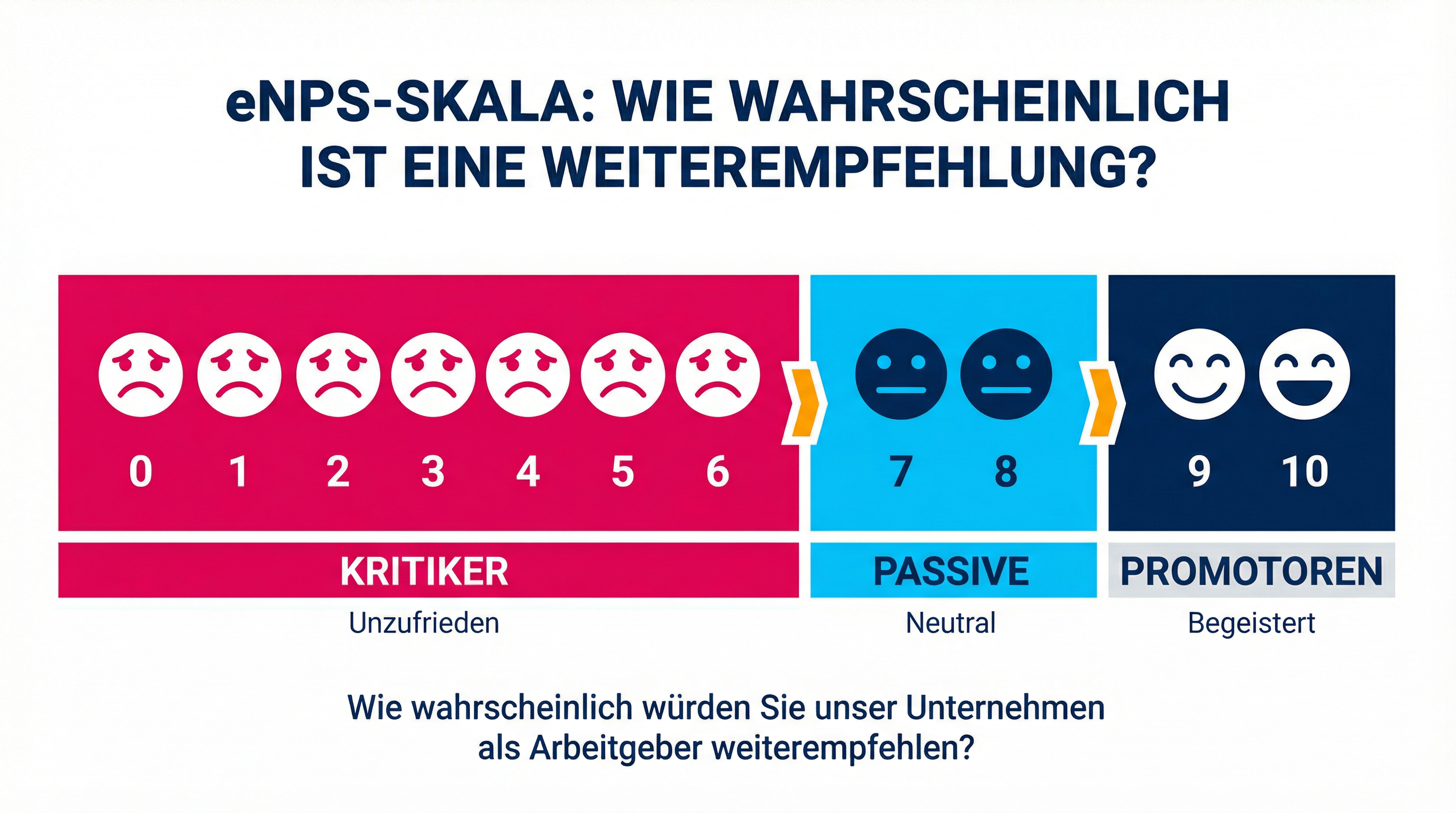
"On a scale of 0 to 10, how likely are you to recommend [Company Name] as an employer to a friend or colleague?"
The answers to this question are used to categorize employees into three groups:
- Promoters: Employees who rate their satisfaction at a 9 or 10. These are your most loyal and enthusiastic employees. Not only are they satisfied with their work, but they also act as active ambassadors for your company. They contribute to a positive work ethic and attract new talent.
- Passive (Passives): Employees who rate their satisfaction as a 7 or 8. These employees are generally satisfied, but not necessarily enthusiastic. They are neutral and may leave your company if a better opportunity arises. They are unlikely to actively promote your company, but they also won’t say anything negative about it.
- Detractors: Employees who give a score of 0 to 6. These employees are dissatisfied and potentially demotivated. Not only can they hinder productivity, but they can also damage your company’s reputation through negative word of mouth and lower team morale.
The eNPS score itself is calculated by subtracting the percentage of detractors from the percentage of promoters. The result is a number between -100 and +100 that provides a quick overview of overall employee loyalty within your company.
eNPS vs. NPS: Differences
Although they are based on the same methodology, the Employee Net Promoter Score (eNPS) and the Net Promoter Score (NPS) target different audiences: employees and customers.
| Feature | eNPS (Employee Net Promoter Score) | NPS (Net Promoter Score) |
| Target audience | Company employees | The company's customers |
| The central question | “How likely are you to recommend [Company] as an employer?” | “How likely are you to recommend [product/brand] to a friend or colleague?” |
| What is being measured? | Employee loyalty, engagement, pride, the strength of the employer brand, and the likelihood of recommendations. | Customer loyalty, satisfaction with the product or service, and the likelihood of repeat purchases and referrals. |
| Strategic Purpose | Improving corporate culture, increasing employee engagement, reducing turnover, and strengthening the employer brand. | Improving the customer experience, increasing customer loyalty, reducing customer churn, and driving organic growth. |
The real strength lies in combining these two metrics. A high eNPS is often an early indicator of a high NPS. Why? Because enthusiastic and engaged employees are more likely to provide excellent customer service, which in turn leads to more loyal and satisfied customers. Companies that measure and optimize both the employee and customer experience create long-term value.
eNPS in the Context of Other Employee KPIs
In modern HR analytics, the eNPS rarely stands alone. It reveals its true value when used in conjunction with other key performance indicators (KPIs). Each metric sheds light on a different aspect of the complex employee experience.
eNPS vs. Employee Satisfaction Index (ESI)
The distinction between loyalty (measured by eNPS) and satisfaction (measured by ESI) is one of the most important in human resources.
Employee satisfaction is a passive state of contentment. A satisfied employee has no immediate pain points. The salary is fair, the tasks are exciting, and the colleagues are nice. Satisfaction is the absence of negativity. However, it is a weak predictor of future behavior. A satisfied employee is not necessarily motivated to go above and beyond, and their commitment to the company is often transactional (a give-and-take). A slightly better offer from a competitor may be enough to trigger a move. High employee satisfaction therefore says little about how strongly employees are committed to the company. Read our article here on how to measure employee satisfaction, including a checklist and questionnaire.
Employee loyalty is an active, emotional bond. The eNPS measures precisely this deeper level of employee engagement and retention. The willingness to use one’s own reputation to recommend the company as an employer is a strong commitment. A high eNPS signals a high alignment with the company’s values and mission. Promoters are not just satisfied. They are the employees who proactively contribute to improvement, positively shape the culture, and act as authentic brand ambassadors.
eNPS vs. Employee Engagement Score
Employee engagement is a broad concept that measures an employee’s emotional and psychological connection to their work, their team, and their company.
- Comprehensive engagement surveys are in-depth diagnostic tools. They typically consist of 20 to 50 questions on various drivers of engagement, such as leadership, development opportunities, recognition, autonomy, and meaningfulness. They provide a rich, detailed picture, but due to their scope, they can usually only be conducted annually or semi-annually.
- The eNPS often serves as an agile pulse check. It is the “tip of the iceberg”—a single, highly sensitive indicator that correlates strongly with overall engagement. Many companies use the eNPS in quarterly or even monthly pulse surveys to monitor sentiment between major engagement surveys. A sudden drop in the eNPS can be an early warning sign that requires a deeper analysis of engagement drivers.
eNPS vs. Turnover and Retention Rates
Turnover and retention rates are hard, indisputable facts about employee turnover in your company.
- Employee turnover is a lagging indicator. It is the result of past events and measures how many employees have already left the company. If the turnover rate is high, the damage has already been done.
- The eNPS is a leading indicator. A declining eNPS, particularly an increase in the number of detractors, is often a reliable early warning sign of an impending wave of resignations. It gives managers and HR teams the opportunity to act proactively and address the causes of dissatisfaction before top talent hands in their notice.
Examples of how to interpret the eNPS
To highlight the strategic importance of the eNPS, we place the calculation examples mentioned above within a broader analytical context. The following table not only shows the eNPS value but also interprets it in light of other potential KPIs and derives strategic recommendations for action.
| Scenario | Advisors | Passive | Critics | eNPS score | Analysis in the Context of KPIs & Strategic Action |
| 1. Medium-sized company | 40% | 45% | 15% | +25 | Context: A solid, positive score. The turnover rate is likely stable, but the high proportion of passive employees (45%) suggests that engagement levels are stagnating. Action: Focus on the passive employees! Analyze their feedback. Often, they lack clear career prospects or recognition. Targeted development programs can turn this group into advocates. |
| 2. Large corporation | 20% | 40% | 40% | -20 | Context: A clear warning sign. This metric likely correlates with high turnover, increased absenteeism, and low customer satisfaction scores (NPS). Action: Urgent action is required! Segment the data by department and location to identify the “hot spots.” Immediately conduct follow-up interviews with critics to understand the root causes. |
| 3. Division Comparison | IT: 60% Sales: 30% | IT: 30% Sales: 40% | IT: 10% Sales: 30% | IT: +50 Sales: 0 | Context: A stark difference in team health. The sales department likely has higher turnover and may not be meeting its goals. Action: Conduct a more in-depth analysis of the factors driving engagement in both departments. Is it due to leadership style, workload, or the commission structure in sales? Use best practices from the IT department as an internal model. |
| 4. Timeline | Q1: 15%
Q3: 35% |
– | Q1: 35% Q3: 15% | Q1: -20 Q3: +20 | Context: An impressive turnaround. The 40-point improvement shows that the measures implemented (e.g., a new feedback culture) were successful. This should have a positive impact on the retention rate in the coming quarters. Action: Communicate this success! Show employees that their feedback leads to real change. Analyze which measures had the greatest impact, and build on them. |
| 5. Start-up | 60% | 33,3% | 6,7% | +53,3 | Context: Excellent performance, typical of an enthusiastic startup phase. Employee satisfaction and engagement are high. The challenge is ensuring sustainability. Action: Enjoy the moment, but stay vigilant. Implement scalable processes for onboarding, feedback, and development now to maintain this positive culture even as the company grows rapidly and the workforce expands. |

Why not just measure employee satisfaction?
It’s a valid question: Isn’t it enough to know whether employees are satisfied? From a strategic perspective, the answer is clear: No. Employee satisfaction alone is an inadequate measure of a company’s long-term success. Here’s why:
- Satisfaction does not equate to performance: A satisfied employee is not necessarily a high-performing or innovative employee. They may fulfill their duties but might sit back and simply “do the bare minimum.” Promoters, on the other hand—who are identified through the eNPS—are emotionally invested and willing to go the “extra mile” to contribute to the company’s success.
- Satisfaction is fragile: Employee satisfaction is often based on transactional factors such as salary, benefits, or a pleasant office environment. These factors are important, but they do not foster deep loyalty. As soon as a competitor offers a slightly higher salary or better benefits, a satisfied employee is more likely to leave. Loyalty, as measured by eNPS, is more resilient to such external offers.
- Satisfaction reflects the present; engagement shapes the future: Employee satisfaction is a measure of how well the current situation is met. Engagement and loyalty are forward-looking. Engaged employees contribute their ideas, bring new perspectives to the table, and drive the company forward. They are the driving force behind innovation and growth.
The eNPS helps companies look beyond the one-dimensional metric of employee satisfaction and measure employees' active, emotional connection to the company.
Who developed the eNPS, and what is its scientific basis?
The origins of the eNPS lie in the field of customer satisfaction research. The methodology was developed by Fred Reichheld, a partner at the management consulting firm Bain & Company. In 2003, Reichheld published an article in the Harvard Business Review titled “The One Number You Need to Grow,” in which he introduced the Net Promoter Score (NPS) as a metric for customer loyalty.
In extensive studies, Reichheld and his team found that the question of the likelihood to recommend correlated more strongly with actual purchasing behavior and customer loyalty than (complex and time-consuming) satisfaction surveys. Its simplicity and strong predictive power quickly made the NPS a global standard in customer management.
Applying this concept to the workplace was a logical next step. Companies realized that the same principles of loyalty and willingness to recommend also apply to their workforce. An employee who recommends their company out of conviction is not only a loyal employee but also a credible ambassador in the job market. Thus, the Employee Net Promoter Score (eNPS) was developed based on the Net Promoter Score (NPS).
- The Psychology of Referrals: A referral is a powerful social signal. When an employee is willing to stake their personal reputation on recommending their employer, it signals a high degree of trust, pride, and satisfaction.
- Simplicity and cognitive ease: Limiting the survey to a single question minimizes the effort required of participants and increases response rates. From a psychological perspective, the question is easy to understand and intuitive to answer, which leads to more honest responses.
However, there is also an academic debate about the limitations of the eNPS. Critics point out that a single metric can never capture the full picture of the complex employee experience. They argue that while the eNPS is a useful starting point, it must be supplemented with qualitative data and additional questions to understand the true causes behind employee feedback.
Why is the eNPS so high?
The popularity of the eNPS is no accident. This metric offers a number of tangible benefits that make it attractive to companies of all sizes and in every industry:
| Advantage | Description |
| Simplicity and speed | The survey often consists of just one or two questions and takes employees less than a minute to complete. This leads to high response rates and delivers quick results. |
| High level of acceptance among employees | Because the process is brief and allows for anonymous participation, there is little hesitation about taking part. Employees are more likely to feel comfortable giving honest feedback. |
| An easy-to-understand metric | The eNPS score is a single, intuitive number that can be easily communicated to executives and the entire company. Whether the score is rising or falling is immediately clear. |
| Benchmarking capability | The eNPS allows you to track your own performance over time (internal benchmarking) and compare yourself to industry standards (external benchmarking). |
| Focus on the ability to act | The eNPS doesn't just provide a diagnosis; it actually forces companies to ask "why." Categorizing customers into promoters, passives, and detractors helps in developing targeted measures. |
| Cost-effectiveness | Compared to time-consuming, traditional employee surveys, conducting eNPS pulse surveys is significantly more resource-efficient. |
| Strong correlation with business results | As mentioned earlier, there is a proven link between a high eNPS, employee engagement, and key business metrics such as productivity, profitability, and customer satisfaction. |
| ue |
The Limitations of the eNPS
- Lack of context: The eNPS tells you what’s going on, but not why. A score of -10 indicates a problem, but not its causes. Is it due to salary, leadership, work-life balance, or company culture? Without a follow-up qualitative question (e.g., “What is the main reason for your rating?”) or additional quantitative questions, the score remains a black box.
- Simplifying reality: The employee experience is a complex interplay of many factors. The eNPS reduces this complexity to a single number. This carries the risk that nuances and specific issues will be overlooked.
- The “silent” passive group: The passive group (rated 7 or 8) is not included in the calculation. However, if a large portion of your workforce is passive, you have a large group of employees who, while not dissatisfied, are also not engaged. Their needs and potential could be overlooked.
- The risk of focusing solely on "score chasing": Executives may be tempted to focus solely on improving the score rather than addressing the underlying issues. This can lead to superficial measures that have no lasting impact.
For these reasons, it is essential to view the eNPS as a starting point for dialogue, not as the end point of the analysis. It is like a thermometer that indicates a need for action, but does not specify what treatment is required.
Checklist: How to Successfully Implement eNPS in Your Company
Successful eNPS implementation requires more than just sending out a question. Careful planning and communication are essential. Use the following checklist as a guide.
Phase 1: Preparation and Planning
☐ Define your goals: What exactly do you hope to achieve with the eNPS survey? (e.g., gauge overall sentiment, identify turnover risks, measure the effectiveness of initiatives).
☐ Inform stakeholders: Secure the support of senior management and executives. Explain the purpose, the process, and the expected benefits.
☐ Ensure anonymity and data protection: Make it clear and unambiguous that responses will be treated anonymously. This is the foundation for honest feedback.
☐ Set the frequency: Decide how often you want to conduct the survey (e.g., quarterly, monthly). The frequency should be high enough to identify trends, but not so high that it leads to “survey fatigue.”
☐ Formulate a follow-up question: Always follow up the eNPS question with an open-ended follow-up question, such as “What is the main reason for your rating?” This is the only way to obtain the necessary context.
☐ Select technology: Use ValueQuest’s professional survey tool to create and distribute the survey in collaboration with specialists, and analyze the results.
Phase 2: Implementation
☐ Clear communication with employees: Announce the survey. Explain why it is being conducted, how the results will be used, and emphasize the importance of participating.
☐ Make it easy to access: Send the survey link via email or embed it on your intranet. Make sure that employees who don’t have constant access to a computer can also participate (e.g., via mobile devices).
☐Send reminders: Send one or two friendly reminders to employees who haven't participated yet to increase the response rate.
Phase 3: Analysis and Action
☐ Analyze results promptly: Calculate the overall eNPS and analyze the results by relevant demographic characteristics (department, location, etc.).
☐ Analyze qualitative feedback: Carefully review the responses to the open-ended question. Identify recurring themes and specific suggestions for improvement.
☐ Communicate results transparently: Share the results with the entire workforce—not just the positive ones, but the critical ones as well. This builds trust and shows that feedback is taken seriously.
☐ Develop specific actions: Based on the results, develop 2–3 specific, actionable steps. Focus on the areas that have the greatest impact on employee satisfaction.
☐ Define responsibilities: Assign clear responsibilities and timelines for implementing the measures.
☐ Communicate progress: Keep employees informed about the progress of the implemented measures. This closes the feedback loop and encourages participation in future surveys.
Guideline: Using the eNPS as a Strategic Tool
The true value of the eNPS only becomes apparent when it goes beyond mere measurement and is understood as a strategic management tool.
- Think in terms of context, not in isolation: Never view the eNPS in isolation. Consider it in relation to other key metrics such as turnover rates, customer satisfaction (NPS), productivity data, and sick leave. Identify the connections and understand how the employee experience directly impacts business success.
- Give managers the data they need: Provide your managers with dashboards that show them the eNPS score for their specific team. Train them to interpret the results and use them to have constructive conversations with their teams. Make employee feedback a regular part of their management routine.
- Focus on the “whys”: The most valuable insights are found in the open-ended comments. Use text analytics tools to automatically analyze the large volume of comments and identify the most important topics. Understand the emotions and specific issues underlying the reviews.
- Close the feedback loop: The biggest demotivator for employees is giving feedback that never elicits a response. Let them know what you’ve heard, what you will do, and what you won’t do (and why). Even if not every request can be granted, transparent communication builds trust.
- Integrate the eNPS into a comprehensive employee experience strategy: The eNPS is just one piece of the puzzle. Combine it with other feedback mechanisms throughout the entire employee lifecycle—from onboarding to development surveys to exit interviews. This is the only way to get a complete picture and make targeted improvements to the aspects that really matter.
By following these guidelines, you can transform the eNPS from a simple metric into a powerful tool that helps you foster a culture of listening, taking action, and continuous improvement. And that is the foundation for a company that not only survives but thrives in the competition for top talent.
Post published on May 10, 2026
About Dr. Kathrin Neumüller

Dr. oec. HSG Kathrin Neumüller is Co-Managing Director at ValueQuest and an expert in employee inspiration and empowerment. She also teaches strategic management in the MBA program at the ZHAW. She holds a doctorate from the University of St. Gallen (HSG) and studied at the University of Cambridge. Learn more about Kathrin
Inspired? Then share this post via your favorite platform.
Other articles that might interest you ...

AI in the Swiss Insurance Market: What Insurers Can Learn from the Results
October 1, 2026
Reading time: 4 min
Artificial intelligence is not universally accepted in the Swiss insurance market. As a study by ValueQuest shows, customers’ openness to AI depends heavily on how it is used.

AI in the Swiss Insurance Market: Between Acceptance and Skepticism
September 28, 2026
Reading time: 5 min
For many Swiss people, artificial intelligence has become an integral part of everyday life. However, the situation is different when it comes to insurance companies.

Top Employer: Raiffeisenbank Glarnerland Impresses with Strong Leadership
September 21, 2026
Reading time: 2 min
ValueQuest recently had the honor of presenting the “Excellence@Work Award” to Raiffeisenbank Glarnerland. We extend our heartfelt congratulations.
Top Swiss Employers: GastroSocial
September 9, 2026
Reading time: 3 min
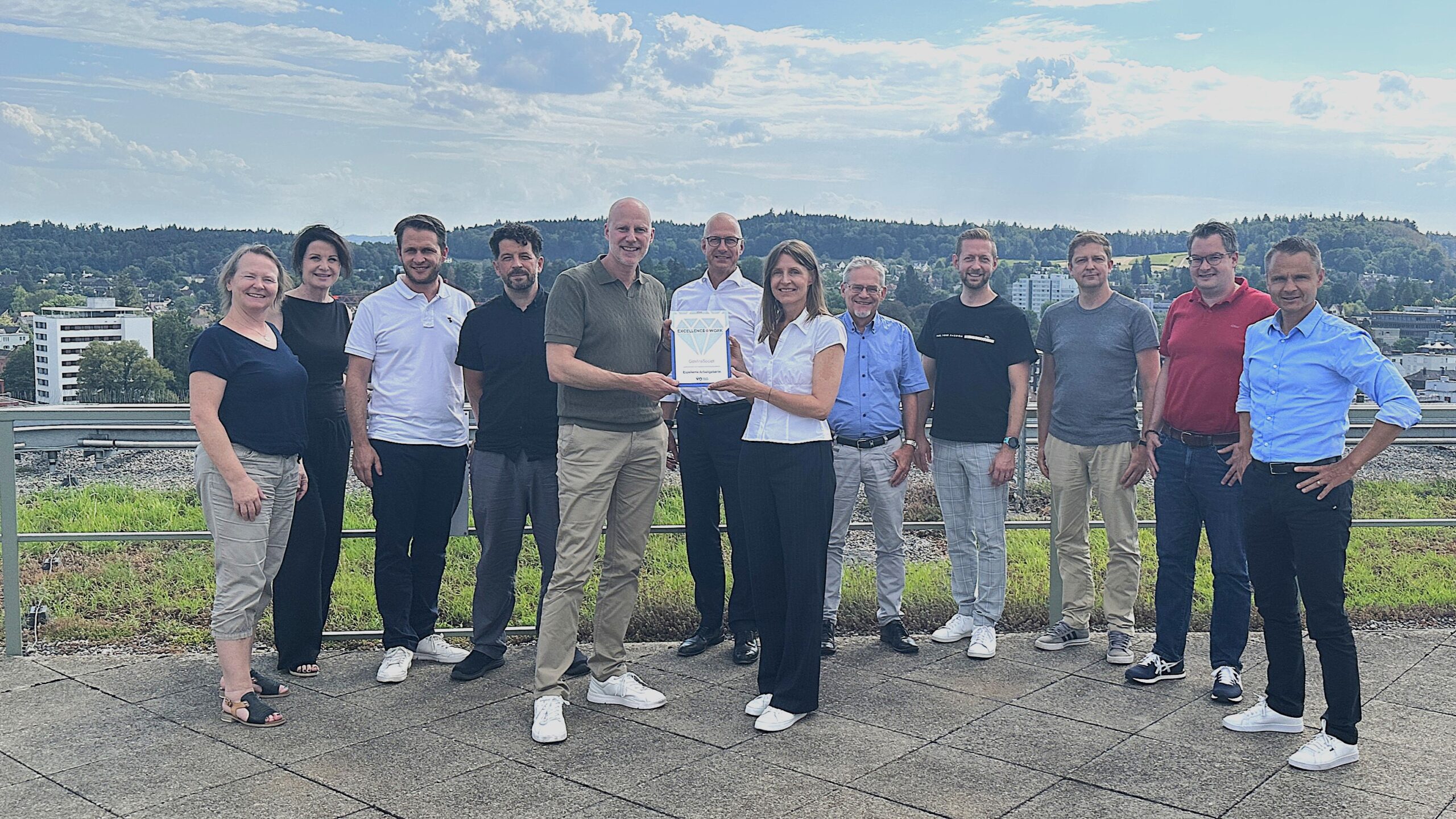
GastroSocial has received the 2026 Excellence@Work Award from ValueQuest. With a response rate of 96 percent, a motivation score of 84, and 87 percent of employees serving as brand ambassadors, the company demonstrates a strong employer culture.

Employee Survey: Raiffeisenbank Möhlin Achieves Excellent Results
August 31, 2026
Reading time: 3 min
Raiffeisenbank Möhlin is one of Switzerland's top employers and is receiving our Excellence@Work Award in recognition of this achievement. Congratulations!

Employee Surveys in Switzerland: Find Providers & Tools
August 30, 2026
Reading time: 6 min
Employee Survey in Switzerland: How Do You Find the Right Employee Survey Provider? What Really Matters When It Comes to Anonymity, Tools, Questionnaires, and Analysis.

360-Degree Feedback Questionnaire: Sample, Template, and Sample Questions
August 21, 2026
Reading time: 7 min
Table of Contents A 360-degree feedback process is only as good as its questionnaire. The questionnaire is at the heart of the entire process. It determines whether...

Employee Survey: The CAMPUS SURSEE Foundation Is Among Switzerland's Best Employers
August 5, 2026
Reading time: 2 min
ValueQuest honors particularly attractive employers in Switzerland with the Excellence@Work Award. We recently had the pleasure of presenting the award to the CAMPUS SURSEE Foundation.

Raiffeisenbank Regio Arbon, a Top Employer: Personal Responsibility as Part of a Strong Corporate Culture
July 7, 2026
Reading time: 2 min
ValueQuest honors particularly attractive employers in Switzerland with the Excellence@Work Award. We recently had the pleasure of presenting the award to Raiffeisenbank Regio Arbon.
