Table of contents
We are in the midst of a leadership crisis. According to Gallup Germany, for example, only 16% of managers are considered effective. Employee dissatisfaction with leadership style and internal resignation are jeopardizing productivity. Researchers at the Gallup Institute measure employee satisfaction annually. While in 2022 almost 50 percent of Germans were still satisfied with their boss, the trend shows a growing distance. The situation is similar in Switzerland.
One thing is certain: leadership has rarely been as much in focus as it has been in recent years. Digitalization, the transition to a knowledge economy, and the trend toward hybrid collaboration raise fundamental questions: What leadership qualities are needed today? What does a contemporary leadership style look like? And how can companies ensure that managers are constantly improving?
In this article, we discuss the top leadership qualities and skills. What does it take to be a successful leader of the future?
Leadership as a skill for the future
The World Economic Forum (WEF) points out in its "Future of Jobs Report 2023" that the demand for leadership skills continues to rise. In addition to analytical and creative thinking, "leadership and social influence" as well as "curiosity and lifelong learning" are among the fastest-growing skills.
The companies surveyed expect that 44% of their employees' core skills will be replaced or changed by technological changes by 2027. Despite the advance of artificial intelligence, leadership and the human factor remain crucial: "It is important to have leadership skills, to be able to exert social influence, and to be able to work with other people." According to the WEF, leadership skills are a key priority in many industries; four out of ten companies plan to invest specifically in leadership development over the next five years. But what is the reality of leadership in practice?
Managers primarily focus their energy on daily business
Leadership development is a necessity. Organizations are feeling this on several fronts: A report by consulting firm Deloitte finds that nearly 40% of managers' and executives' working time is spent on operational business and "firefighting." This includes ad hoc problem solving or administrative tasks, while only 15% of time is spent on strategy and 13% on employee development. At the same time, 36% of executives feel inadequately prepared for their role and criticize the lack of technological support. Although 73% of the companies surveyed recognize the relevance of redefining leadership, according to Deloitte, only 7% say they are making significant progress. There is a gap between what leadership is and what it should be. 360-degree feedback is an important leadership tool for closing this gap.
In addition, the Gallup study"State of the Global Workplace 2024"shows that employee engagement worldwide has fallen from 23% to 21% across all employees surveyed in 2024. Managers are experiencing the sharpest decline. Engagement among managers fell from 30% to 27%, while it remained constant among employees without management responsibilities.
360-degree feedback: Study by ValueQuest
Our leadership study is based on over 1,000 360-degree feedback surveys conducted in various industries in Switzerland. Each participating manager first assesses themselves ("self-image") based on 20 leadership dimensions that reflect competencies. At the same time, supervisors, employees, peers, and—depending on their role—customers or business partners also give their assessment of the respective leadership skills.

The percentages in the following tables indicate how often a particular leadership skill is mentioned as an area for development by a respective feedback group. Since each person could specify several development topics or leadership skills, the values within a group add up to more than 100%. This results in a priority profile. The total sum across all 20 leadership competencies reflects how many different topics someone simultaneously considers relevant for developing good leadership skills.
Overall view of development issues (total of mentions of all 20 competencies)
| feedback role | Sum of the percentages | comment |
| Self-image (self-concept) | 365 | Managers see many areas for development in themselves. |
| Supervisor | 333 | Supervisors of the evaluated managers also express high expectations. |
| peers | 275 | Colleagues are somewhat more lenient. |
| employees | 238 | Teams mention fewer topics—the focus on specific leadership skills is clearer. |
| Customers/Business Partners | 237 | Similar to employees, but more external. |
Both self-image and superiors paint the broadest development profile. A value of 365 in self-image means that the managers surveyed perceive a high density of development topics in themselves. Peers, employees, and customers, on the other hand, set clearer priorities.
The following roles were distinguished in the 360-degree feedback:
- Self-image = the manager themselves who participates in the 360-degree feedback (the person being surveyed)
- Superiors = the direct superiors of this manager (e.g., division management, executive management, CEO)
- Employees = direct reports of the manager
- Peers = colleagues at the same management level
- Customers/business partners = external or internal stakeholders, depending on their role
Top leadership skills: What leaders should develop today
Our study of more than 1,000 360-degree feedback reports shows that the classic, authoritarian top-down management style has largely become obsolete. Modern leadership focuses on people, teams, and the interfaces between teams. The most frequently mentioned leadership skills that managers should develop more strongly can be grouped into five core areas (average values across all respondents):
1. Providing impetus and inspiration (21%) – Managers should provide impetus, stimulate innovation, and communicate visions. This includes developing new ideas and implementing them, but also the ability to initiate change. This approach is closely linked to the concept of "inspirational leadership," which aims to motivate employees through a compelling vision rather than simply giving instructions (see Bass & Avolio, 1994).
2. Communicate effectively (20%) – Clear and understandable communication is one of the key expectations across all feedback groups. Studies, such as those conducted by the Project Management Institute (PMI), repeatedly show that ineffective communication is one of the main causes of project failure.
3. Promote collaboration (19%) – Teams expect managers to actively promote cooperation and break down silos. This includes building bridges between teams, facilitating interfaces, and establishing common goals.
4. Responding to others (19%) – Empathy, listening, and responding to individual needs are highly valued.
5. Involve those affected (17%) – Employees want to be involved at an early stage in changes or decisions.
These top leadership skills show that modern leadership must above all be connective, dialogue-oriented, and inclusive. Authority and control take a back seat; they are replaced by clarity, presence, and the active shaping of relationships.
Leadership skills: The "hygiene factors"
It is also interesting to look at the least frequently mentioned development topics in the area of leadership. These are at the bottom of the ranking and are rarely mentioned by respondents as areas for development:
| expertise | Total in % | comment |
| Striving for excellence | 6 | The pursuit of excellence is taken for granted or not questioned. |
| Tackling challenges | 6 | Active "hands-on" involvement is apparently perceived as existing or a matter of course. |
| Taking responsibility | 7 | Employees expect clarity and consistency, but do not see this as a top priority. |
| Work effectively | 7 | Efficient, effective work is considered a hygiene factor. |
| Demonstrate profile and integrity | 9 | Integrity is expected, but rarely emphasized as an area for development. |
| make decisions | 9 | Decision-making ability is a basic requirement, not a priority area for development. |
The low scores do not automatically mean that these skills are unimportant. Rather, they are taken for granted in many organizations. Only when they are lacking do they become a problem. However, companies should be mindful, because a lack of responsibility and consistency can lead to irritation among employees, even if it is not a top leadership issue.
Leadership behavior – Where are the shortcomings?
Analyzing the different perspectives reveals the biggest areas of tension and "blind spots" in everyday management. What do managers think about themselves?
Managers rate their own development needs in terms of leadership skills higher than their superiors, peers, customers, or employees (their team) do.
It is particularly striking that they view themselves most critically when it comes to the "technical" aspects of leadership. They perceive topics such as "planning and organizing work" (31% self-image vs. 17% employees) or "monitoring and recognizing performance" (26% self-image vs. 15% employees) as significantly more urgent areas for development. They feel the operational pressure most strongly.
Blind spots of leaders
The biggest "blind spots" are evident when comparing responses with those of supervisors. While managers hardly see "taking responsibility" as an area for development (1%), their supervisors demand it much more strongly (8%). Similar discrepancies exist in "showing profile and integrity" (10% self-image vs. 16% superiors) and "actively addressing change" (16% self-image vs. 22% superiors). This is a matter of strategic effectiveness and perceived ownership.
Employees and managers: Where do the requirements for leadership differ?
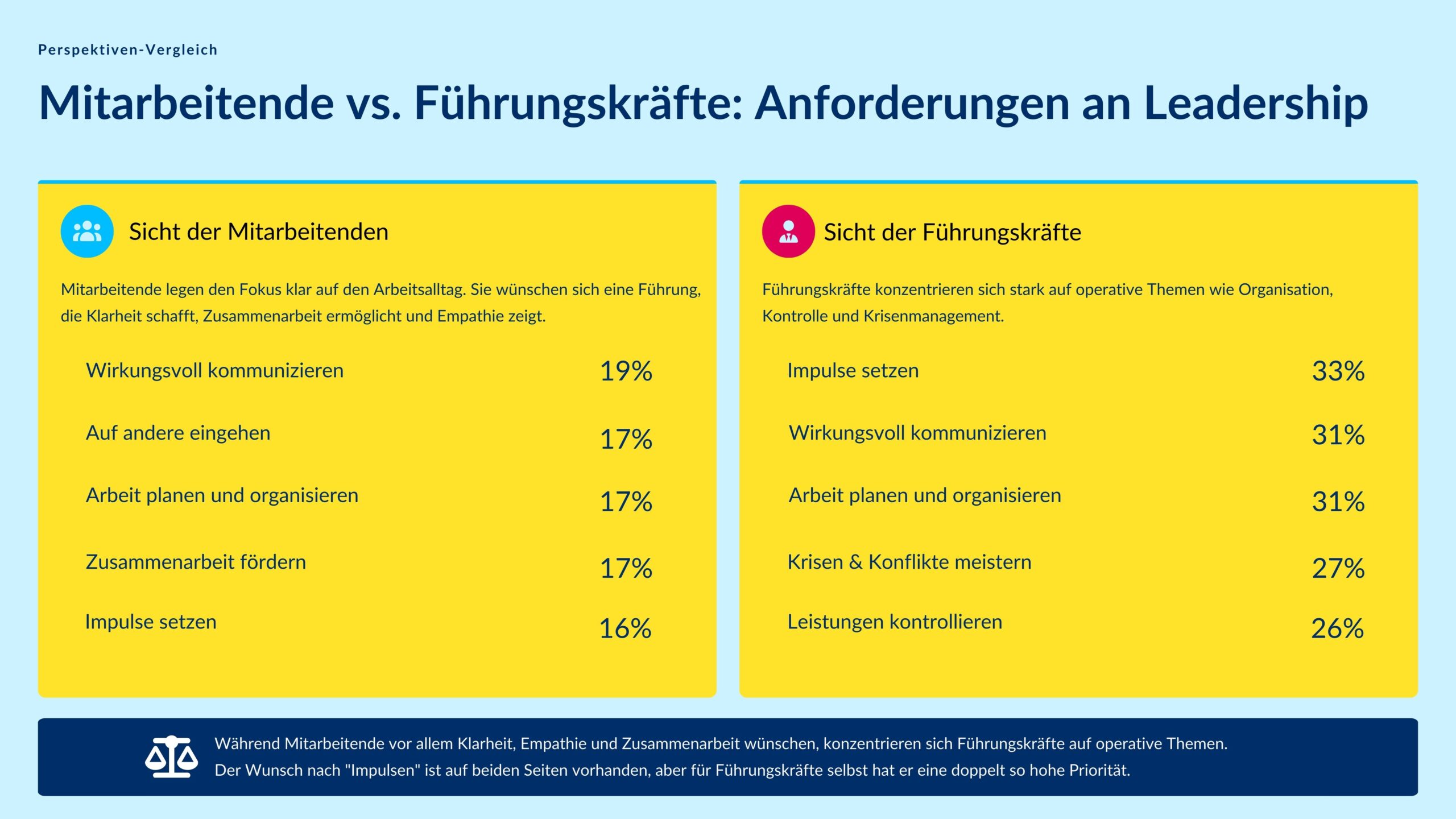
Employees clearly focus on their everyday work. For them, the most important areas for development are:
| Top 5 areas for development (employees' perspective) | mentions |
| 1. Communicate effectively | 19% |
| 2. Respond to others | 17% |
| 3. Plan and organize work | 17% |
| 4. Promote cooperation | 17% |
| 5. Setting the tone | 16% |
In comparison, the self-perception of managers:
| Top 5 areas for development (from the perspective of managers) | mentions |
| 1. Setting the tone | 33% |
| 2. Communicate effectively | 31% |
| 3. Plan and organize work | 31% |
| 4. Overcoming crises and conflicts | 27% |
| 5. Check and acknowledge performance | 26% |
While managers focus heavily on operational issues such as organization, control, and crisis management, employees primarily want leadership that creates clarity (communication), facilitates cooperation, and shows empathy (responding to others). Although the desire for "impulses" exists on both sides, it is twice as high a priority for managers themselves.
360-degree feedback: How to eliminate blind spots
Blind spots are among the most common problems in leadership. They arise when one's self-image does not match the perception of others. 360-degree feedback, also known as leadership feedback, helps to identify these discrepancies between self-perception and external perception by providing a holistic picture of strengths and areas for development.
What makes 360-degree feedback special is the comprehensive view it provides: managers are not only assessed by their superiors, but also gather feedback from employees, business partners, and peers in their own management circle. Blind spots can arise in communication—for example, when managers unconsciously send contradictory messages—in delegation ("micromanagement vs. delegation") or in emotional intelligence. Feedback from multiple sources makes it possible to address these leadership issues openly.
ValueQuest has developed a feedback tool with a clearly structured competency model that is evaluated anonymously so that feedback can be open and honest. The feedback process is accompanied by discussions with trained coaches so that concrete development plans can be created based on the findings. The 360-degree feedback primarily measures leadership behavior and leadership competencies —less hard performance indicators and more soft leadership factors such as communication behavior, decision-making ability, teamwork, problem-solving, empowerment, and empathy. Learning only occurs through such honest feedback. Read more about the psychology of feedback here!
Leadership development: Checklist and tips
What do these results mean for managers and organizations? Several areas for action can be derived from the data:
- Focus on communication and empathy. The most common development requests employees make of their managers revolve around clear communication, active listening, and treating employees with empathy. Managers should learn to formulate expectations transparently, give regular feedback, and engage in dialogue.
- Actively promoting cooperation and participation. Teams want managers to be bridge builders and break down silos. This means involving people, engaging those affected, and facilitating cross-team projects. Agile working methods, joint decision-making, and interdisciplinary collaboration can help with this.
- Do not neglect operational skills. Managers' self-image shows that they place great value on planning, organization, and conflict management. These "technical" skills form the basis on which empathetic and inspiring leadership can be built. Training courses on time management, project management, and conflict resolution remain relevant.
Contact us if you would like a comprehensive, tailor-made leadership development program. Barbara Haimoff
- Identify blind spots through feedback. Discrepancies between self-image and external image require attention. 360-degree feedback, regular employee surveys, and coaching discussions help to reveal hidden areas for development and work on them in a targeted manner. It is important that managers accept feedback openly and view it as an opportunity for further development.
- Rethinking the role of management: From manager to leader. Organizations should rethink the role of their managers and reduce administrative burdens. Technological support—such as AI-powered tools for decision-making or simplifying administrative tasks—can help give managers more time for people management. At the same time, clear expectations should be formulated regarding what a manager should achieve: developing people, promoting collaboration, and enabling innovation.
- Strategically anchor leadership development. International research shows that companies that invest specifically in leadership development achieve better results. Leadership training, coaching, and mentoring must be an integral part of human resources strategy.
Post published on January 27, 2026
About Bruno Catellani

Inspired? Then share this post via your favorite platform.
Other articles that might interest you ...

AI in the Swiss Insurance Market: What Insurers Can Learn from the Results
October 1, 2026
Reading time: 4 min
Artificial intelligence is not universally accepted in the Swiss insurance market. As a study by ValueQuest shows, customers’ openness to AI depends heavily on how it is used.

AI in the Swiss Insurance Market: Between Acceptance and Skepticism
September 28, 2026
Reading time: 5 min
For many Swiss people, artificial intelligence has become an integral part of everyday life. However, the situation is different when it comes to insurance companies.
Top Employer: Raiffeisenbank Glarnerland Impresses with Strong Leadership
September 21, 2026
Reading time: 2 min
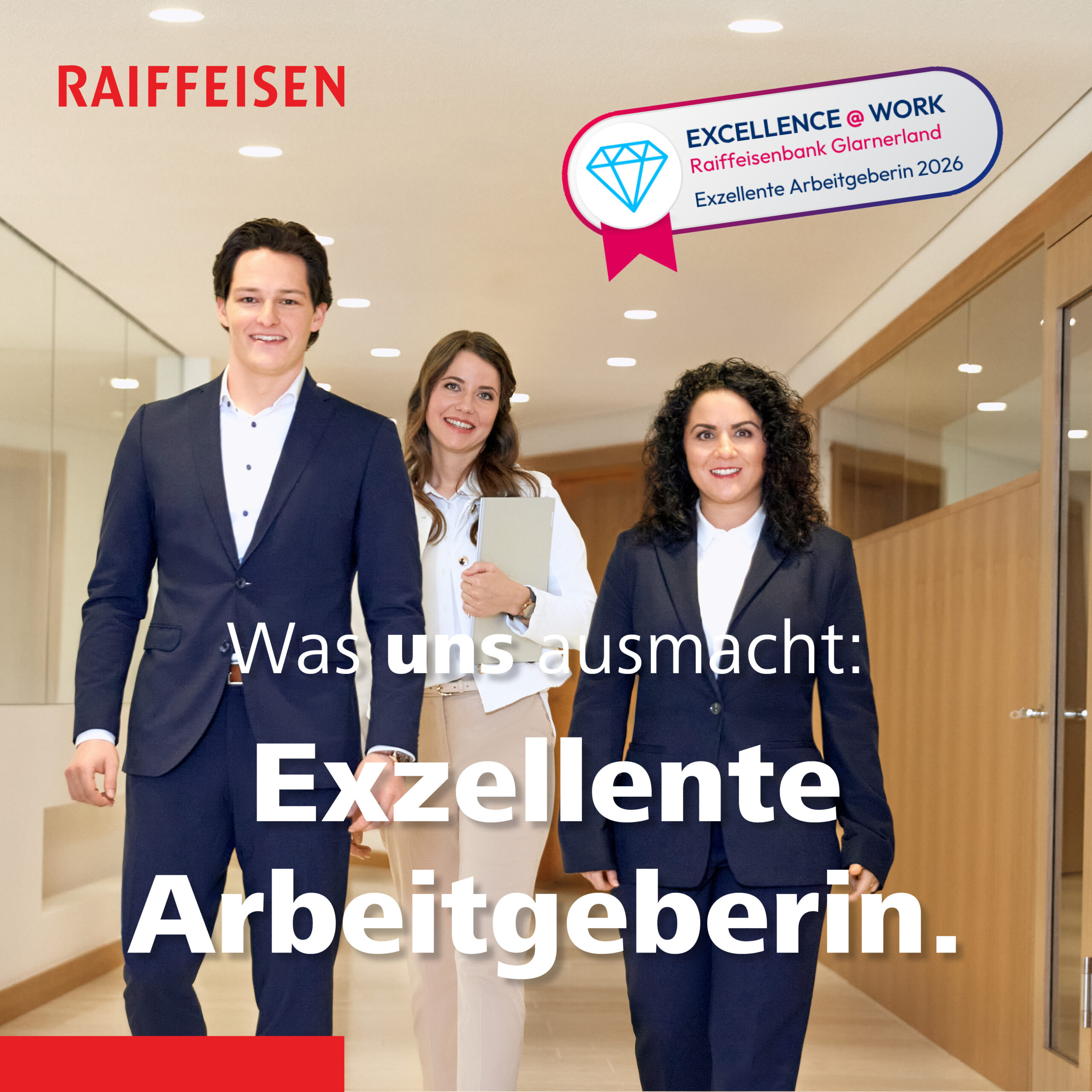
ValueQuest recently had the honor of presenting the “Excellence@Work Award” to Raiffeisenbank Glarnerland. We extend our heartfelt congratulations.
Top Swiss Employers: GastroSocial
September 9, 2026
Reading time: 3 min
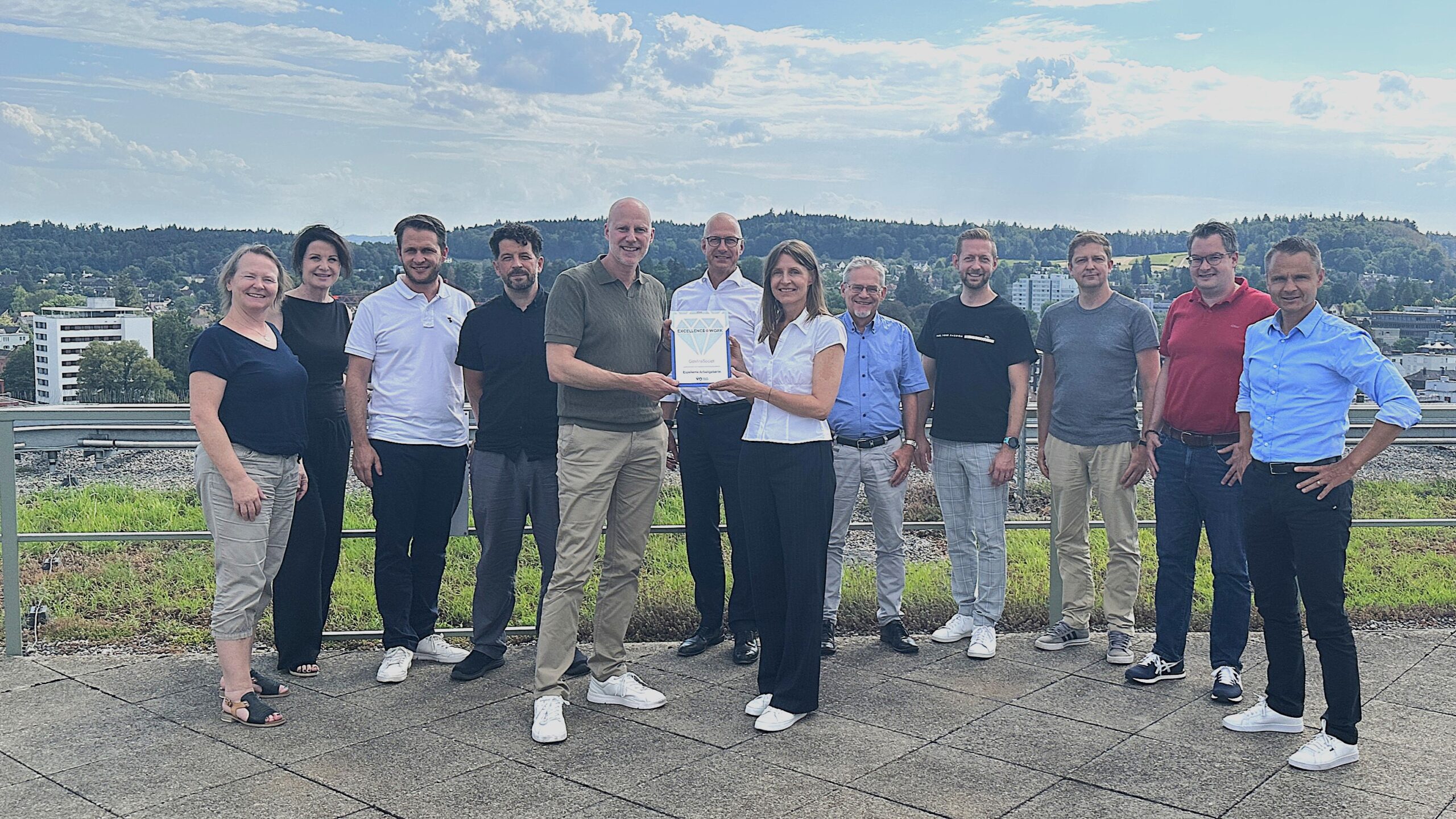
GastroSocial has received the 2026 Excellence@Work Award from ValueQuest. With a response rate of 96 percent, a motivation score of 84, and 87 percent of employees serving as brand ambassadors, the company demonstrates a strong employer culture.

Employee Survey: Raiffeisenbank Möhlin Achieves Excellent Results
August 31, 2026
Reading time: 3 min
Raiffeisenbank Möhlin is one of Switzerland's top employers and is receiving our Excellence@Work Award in recognition of this achievement. Congratulations!

Employee Surveys in Switzerland: Find Providers & Tools
August 30, 2026
Reading time: 6 min
Employee Survey in Switzerland: How Do You Find the Right Employee Survey Provider? What Really Matters When It Comes to Anonymity, Tools, Questionnaires, and Analysis.

360-Degree Feedback Questionnaire: Sample, Template, and Sample Questions
August 21, 2026
Reading time: 7 min
Table of Contents A 360-degree feedback process is only as good as its questionnaire. The questionnaire is at the heart of the entire process. It determines whether...

Employee Survey: The CAMPUS SURSEE Foundation Is Among Switzerland's Best Employers
August 5, 2026
Reading time: 2 min
ValueQuest honors particularly attractive employers in Switzerland with the Excellence@Work Award. We recently had the pleasure of presenting the award to the CAMPUS SURSEE Foundation.
Raiffeisenbank Regio Arbon, a Top Employer: Personal Responsibility as Part of a Strong Corporate Culture
July 7, 2026
Reading time: 2 min
ValueQuest honors particularly attractive employers in Switzerland with the Excellence@Work Award. We recently had the pleasure of presenting the award to Raiffeisenbank Regio Arbon.