Employee surveys are one of the most important tools for personnel and organizational development in many Swiss companies. They provide valuable insights into the working atmosphere, uncover blind spots in cooperation and create a sound basis for targeted improvements.
Employee surveys are becoming increasingly important, especially in times of skills shortages, rising expectations of younger generations and declining employee loyalty. They help to identify risks at an early stage, make potential visible and effectively strengthen trust and cooperation within the company.
However, anyone considering such a survey is quickly faced with practical questions:
- How expensive is an employee survey in Switzerland?
- Should you use an internal tool or be supported by a specialized provider?
- When is a full-service provider worthwhile?
In this article, we provide an overview of the most important questions relating to costs, prices and implementation. We show what prices SMEs and larger companies should expect and what is important when choosing the right provider.
Table of contents
What does an employee survey cost in Switzerland?
The first question that many HR managers and executives ask themselves is: What does it all cost?
One thing is clear: the costs of an employee survey depend heavily on the scope, the method and the size of the company. The following factors, among others, are decisive:
- the number of employees and the complexity of the organization
- the questionnaire (standardized or customized, number of languages)
- the survey method (online survey, hybrid or on paper)
- and the selected provider
In practice, prices for smaller Swiss companies start at around CHF 3,500 to CHF 6,000. These are compact, standardized solutions for SMEs. For larger companies with several locations, for example in different countries, as well as multilingual questionnaires, customized content and in-depth evaluation, the costs can quickly rise into the five-digit range.
As a general rule, it is difficult to give all-inclusive prices. The price of an employee survey always depends on the anticipated effort involved. Depending on the objective, the depth of the survey and the requirements for consulting, evaluation and reporting, this effort can vary greatly.
“
At ValueQuest, we are committed to absolute price transparency for our clients. We create a cost ceiling for you that you can rely on. Without any hidden costs.
Contact me for a non-binding offer.
What do the costs of an employee survey depend on?
The costs of an employee survey can vary greatly depending on the size of the company, the objectives being pursued and the complexity of the implementation. As a general rule, the larger and more demanding the project, the greater the effort and therefore the higher the costs.
#1: Number of employees
Many providers scale their prices according to the number of participants. This means that the more employees are surveyed, the higher the total price. At the same time, the price per person decreases, as fixed costs such as set-up, technical implementation and project management are spread over more people.
For example, a survey for 20 employees costs more per person than the same survey for 100 people because the fixed costs are spread more widely. With increasing size, however, the requirements for evaluation and coordination also increase. Although large companies pay more in total, they benefit from economies of scale. Smaller companies, on the other hand, can work well with standardized solutions.
To summarize:
- More participants reduce the price per person
- Fixed costs are incurred regardless of the size of the company
- Economies of scale arise in larger organizations
#2: Questionnaire and consulting effort
The questionnaire is the heart of every survey. A central cost factor is the questionnaire design. The more rounds of voting are required, the higher the cost.
- Standardized questionnaires are based on tried and tested questionnaires. They can be expanded on a modular basis, enable benchmark comparisons with other companies in the same sector and are efficient as they are already preconfigured. This variant is particularly useful for SMEs that value proven structures and an attractive price.
- Individual questionnaires are tailored to the specific requirements and strategic goals of a company. They offer maximum fit, but require more time for design, coordination and technical implementation in the survey tool. These questionnaires are suitable, for example, for companies that are undergoing reorganization, are strongly driven by innovation, have special management models or values or have specific requirements in their industry.
To summarize:
- Standard questionnaires are cost-effective and offer a meaningful benchmark comparison
- Individual questionnaires offer a better fit, but cost more
- The cost of tuning and programming directly influences the price
#3: Length of the survey
Shorter employee surveys are not only easier for employees to complete, but also involve less effort for providers. However, the results are generally less meaningful due to the small number of responses. Especially when working with the results, there is often a lack of differentiation as to which aspects of a topic are viewed particularly critically.
More extensive surveys with additional modules, open free text fields or specific questions can significantly increase the workload. Employees need more time to complete the survey and qualitative comments must be carefully evaluated.
Added to this is the cost of consulting: if external experts are involved in the development and coordination of the questionnaire, this is also reflected in the price. However, a methodologically sound questionnaire is crucial in order to achieve usable and valid results.
To summarize:
- Extensive questionnaires with free text fields increase the workload
- External advice is worthwhile, but entails additional costs
#4: Survey method: online survey or paper survey
Online surveys are standard today. The invitations are sent by email or link, and the employees answer the questionnaire conveniently on their PC or smartphone, usually via a personalized access. The answers are automatically transmitted to the provider (e.g. ValueQuest) and evaluated directly. Reminder emails help to improve the response rate.
Online surveys are not only user-friendly, but also cost-efficient. If possible, this format should be preferred. Paper surveys should be used specifically where digital solutions are not realistic, for example for production employees without a PC. Paper surveys require significantly more effort: printing, mailing and return costs are incurred, and manual data entry is error-prone and time-consuming. Nevertheless, they are still relevant in certain sectors, such as production, retail, construction and logistics.
Find out more about our industry-specific offers on our industry page.
To summarize:
- Online surveys are cheaper and easier to implement
- Paper surveys cause higher costs and more effort
- Paper questionnaires are still necessary in certain sectors (construction, logistics)
#5: Multilingualism
Multilingualism is a key issue in Switzerland. A survey in German alone is not enough for many companies. If the survey is also offered in French, Italian or English, this increases acceptance and the participation rate.
However, additional language versions also incur additional costs: each version must be precisely formulated linguistically, tested and technically integrated into the survey tool. Multilingual versions are also often required for evaluation and reporting.
Our cost-effective standard solution already includes German, French, Italian and English. This standard solution is aimed in particular at SMEs.
For customized projects, additional languages can be added on request, for example Hungarian, Portuguese, Spanish or Chinese. ValueQuest not only handles the translation of the questionnaire, but also the linguistically correct layout of the reports.
To summarize:
- Multilingualism increases acceptance and response rate
- Additional languages cause translation and integration costs
- ValueQuest offers a wide range of languages including report translation
#6: Complexity of the organization and depth of evaluation
Reporting must be geared towards the specific organizational structure, be it at company, location, department or team level. Only in this way can results be reflected back in a targeted manner and processed effectively.
The more complex a company, the greater the effort required for project setup, coordination and reporting. A simple example: if 50 employees have to be distributed across 5 teams, this can be implemented quickly. If, on the other hand, the organization consists of 500 employees in 50 teams, the planning and coordination effort increases significantly. In addition, there are often multilingual evaluations, different report recipients and additional data protection requirements.
In the case of groups with different business units and locations in several countries, the effort involved is particularly high. A lot of time must be invested in the run-up to the survey in order to generate a meaningful survey structure.
In addition to a consolidated overall report, providers of employee surveys create differentiated evaluations - for example:
- Site-specific reports
- Departmental or divisional reports
- Reports at team or management level
Our experience shows: It is the reports at team level that make the decisive difference. Because only when managers and their teams are aware of their own results can they react to them in a targeted manner. This makes the survey effective and turns it into a genuine instrument for change.
Decentralized companies with many locations, units or subsidiaries in particular often produce a large number of individual reports - sometimes several hundred. These must be:
- individually created
- carefully checked
- and processed in compliance with data protection regulations
A key point here is that groups below a defined minimum evaluation threshold - usually five participants - must not be evaluated separately. Otherwise, there is a risk that feedback from individual people can be attributed. This threshold must be jointly defined in the planning phase.
To summarize:
- The reporting structure should correspond to the organization
- Greater complexity increases effort and costs
- Reports at team level promote real change
- Data protection requires clear evaluation thresholds
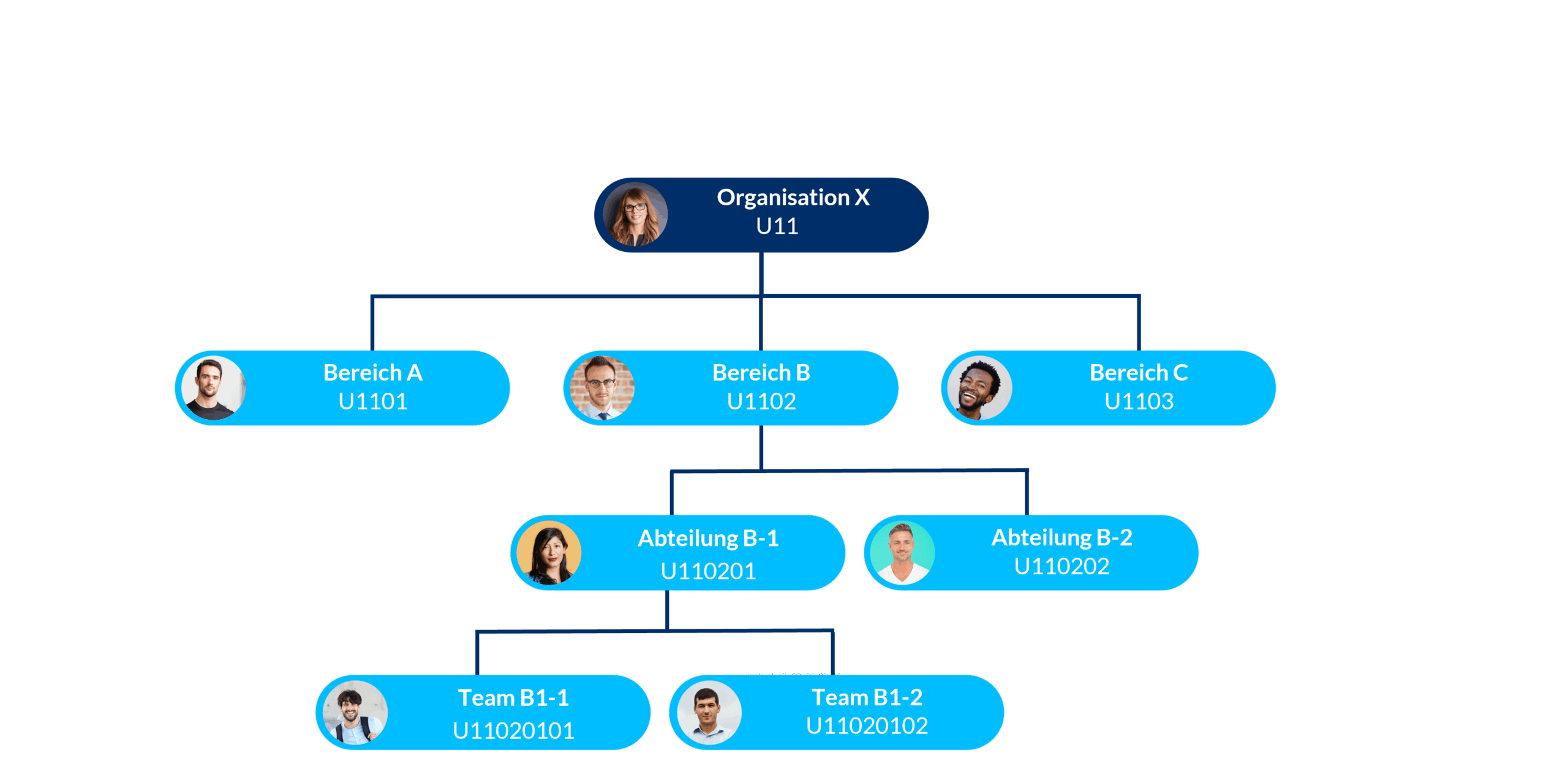
In the image below, you can see that the evaluation structure is based on the organization chart of the respective organization. This allows different teams and many hierarchy levels to be mapped. Employees can be meaningfully grouped into clusters, for example by department or function. The reporting structure allows internal benchmarking at several hierarchy levels. Team results can be compared directly within the same level, for example team A vs. team B.
Is there financial support for SMEs for employee surveys?
Yes, the Friendly Work Space label from Health Promotion Switzerland in particular offers SMEs financial support. As part of this program, small and medium-sized companies can carry out an external employee survey - professionally and effectively - thanks to partial funding from as little as CHF 3,000.
How much does an employee survey cost to implement?
Good providers point out at an early stage that follow-up measures (workshops, employee presentations, coaching) should be planned. These include, for example, team workshops, moderated feedback discussions or topic-specific project groups in order to jointly derive concrete improvement measures from the results.
These follow-up measures also require effort (in terms of time and money) and should be included in the budget from the outset. A proven rule of thumb is: at least 50 percent of the total budget should be reserved for the follow-up process.
This includes both external services such as moderation or consulting as well as internal resources, such as the HR team's time for accompanying workshops.
We at ValueQuest will be happy to support you in the implementation according to your needs. Find out more!
Our follow-up offer for the implementation of employee feedback
A successful employee survey does not end with the presentation of the results. To ensure that the findings have an impact, we provide you with targeted support during implementation:
- Presentation of results: Preparation and presentation of the results for management, HR and employees.
- Team workshops: Moderated workshops to generate and derive measures.
- Train-the-trainer sessions: Knowledge transfer within the company so that team leaders can work independently with the results in their teams.
- Individual coaching: For managers or HR managers in dealing with employee feedback and change processes.
- Keynote speeches & keynotes: Inspiration and impulses for teams, leadership or entire organizations.
Our follow-up modules can be flexibly combined. Find out more about implementation support for your employee survey here.
Which is better for employee surveys? Self-service or full service?
At first glance, self-service tools often seem cheaper. But if you take a closer look, you quickly realize that the true price is only revealed in the total cost. In the overall assessment, full-service offers often perform better.
What self-service tools are available for surveys? What dodo they cost?
Software-based self-service solutions such as Microsoft Viva Glint or the AXA Work Climate Compass enable companies to plan and carry out their employee surveys themselves. At first glance, the license costs appear attractive:
- Microsoft Viva Glint: approx. €1.87 (CHF 1-75.-) per employee per month
- AXA Work Climate Compass (standard product): from CHF 2,250 per year for up to 100 employees
However, these seemingly inexpensive solutions come with hidden costs. The HR team has to design the questionnaire, plan the communication, conduct the survey, analyze the data and interpret the results. All of this requires internal know-how, time and experience.
What's more, there is no external perspective. This can be problematic, especially when it comes to sensitive topics such as a culture of mistrust or strategically important issues. A misinterpreted evaluation or unclear communication can severely damage the credibility of HR and management as a whole.
📌When is self-service worthwhile and when is it not
Self-service models are only suitable if internal
- Sufficient personnel capacity
- sound methodological expertise
- and experience in dealing with critical feedback
If one of these elements is missing, the supposedly low-cost model can quickly become expensive. Be it through additional costs, reputational risks or unused results.
The trust of employees in surveys should not be underestimated. If employees do not trust the organization and fear that anonymity is not sufficiently guaranteed by the survey via the self-service tool, this can be reflected in a very low participation rate. If there is concern that the employer will be able to draw conclusions about individuals, responses may be less honest than when working with a full-service provider that guarantees anonymity.
What does a professional full-service provider offer?
With specialized providers such as ValueQuest, you receive an end-to-end full-service offer. From well-founded questionnaire development and technical implementation to data protection-compliant evaluation and targeted action support, everything from a single source.
- At ValueQuest, standardized survey packages for SMEs start at CHF 3,500 - CHF 6,000
- These include benchmarks, a proven methodology and personal advice
- For larger organizations, we develop tailor-made solutions that also cover complex structures and multilingual reports
The added value lies not only in the time saved for your HR department, but also in the independent external perspective, the scientifically sound analysis and the positive impact on your management and corporate culture. External service providers and suppliers conduct your employee survey with objectivity, anonymity and confidentiality. Find out more here.
Article published on August 4, 2025
About Dr. Kathrin Neumüller

Dr. oec. HSG Kathrin Neumüller is Co-Managing Director at ValueQuest and an expert in employee inspiration and empowerment. She also teaches strategic management in the MBA program at the ZHAW. She holds a doctorate from the University of St. Gallen (HSG) and studied at the University of Cambridge. Learn more about Kathrin
Inspired? Then share this post via your favorite platform.
Other articles that might interest you ...

AI in the Swiss Insurance Market: What Insurers Can Learn from the Results
October 1, 2026
Reading time: 4 min
Artificial intelligence is not universally accepted in the Swiss insurance market. As a study by ValueQuest shows, customers’ openness to AI depends heavily on how it is used.

AI in the Swiss Insurance Market: Between Acceptance and Skepticism
September 28, 2026
Reading time: 5 min
For many Swiss people, artificial intelligence has become an integral part of everyday life. However, the situation is different when it comes to insurance companies.

Top Employer: Raiffeisenbank Glarnerland Impresses with Strong Leadership
September 21, 2026
Reading time: 2 min
ValueQuest recently had the honor of presenting the “Excellence@Work Award” to Raiffeisenbank Glarnerland. We extend our heartfelt congratulations.
Top Swiss Employers: GastroSocial
September 9, 2026
Reading time: 3 min
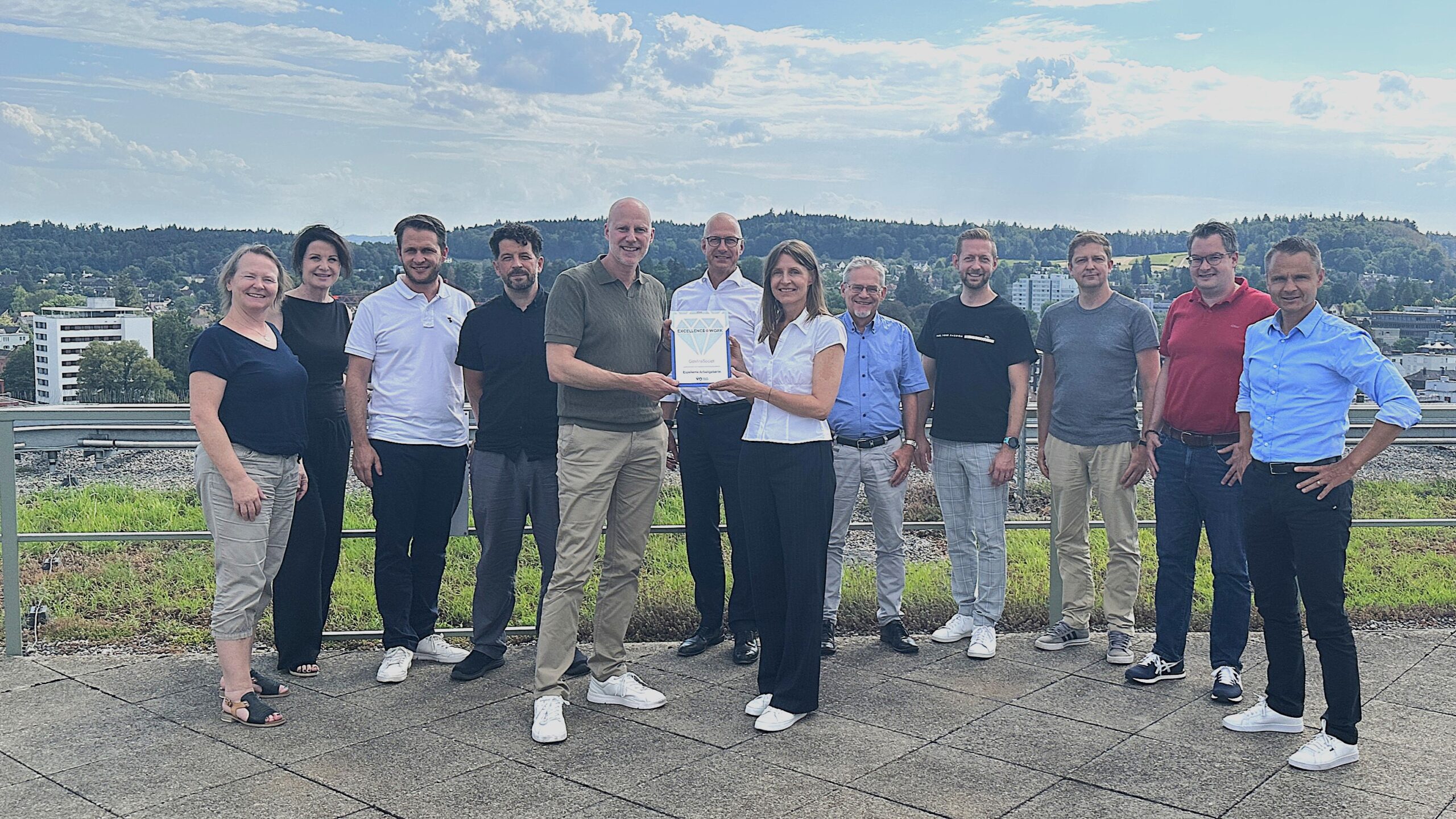
GastroSocial has received the 2026 Excellence@Work Award from ValueQuest. With a response rate of 96 percent, a motivation score of 84, and 87 percent of employees serving as brand ambassadors, the company demonstrates a strong employer culture.

Employee Survey: Raiffeisenbank Möhlin Achieves Excellent Results
August 31, 2026
Reading time: 3 min
Raiffeisenbank Möhlin is one of Switzerland's top employers and is receiving our Excellence@Work Award in recognition of this achievement. Congratulations!

Employee Surveys in Switzerland: Find Providers & Tools
August 30, 2026
Reading time: 6 min
Employee Survey in Switzerland: How Do You Find the Right Employee Survey Provider? What Really Matters When It Comes to Anonymity, Tools, Questionnaires, and Analysis.

360-Degree Feedback Questionnaire: Sample, Template, and Sample Questions
August 21, 2026
Reading time: 7 min
Table of Contents A 360-degree feedback process is only as good as its questionnaire. The questionnaire is at the heart of the entire process. It determines whether...

Employee Survey: The CAMPUS SURSEE Foundation Is Among Switzerland's Best Employers
August 5, 2026
Reading time: 2 min
ValueQuest honors particularly attractive employers in Switzerland with the Excellence@Work Award. We recently had the pleasure of presenting the award to the CAMPUS SURSEE Foundation.
Raiffeisenbank Regio Arbon, a Top Employer: Personal Responsibility as Part of a Strong Corporate Culture
July 7, 2026
Reading time: 2 min
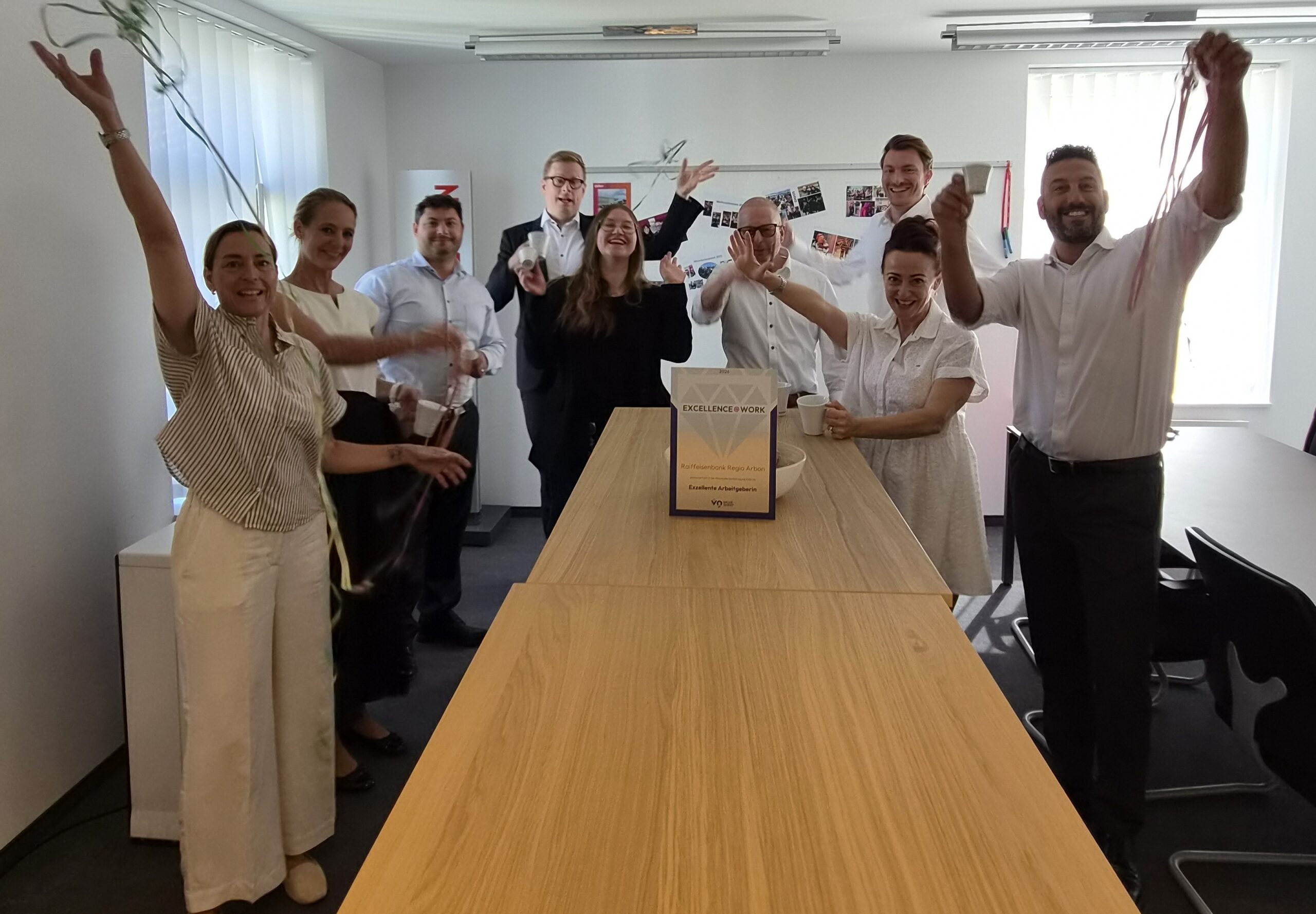
ValueQuest honors particularly attractive employers in Switzerland with the Excellence@Work Award. We recently had the pleasure of presenting the award to Raiffeisenbank Regio Arbon.