The discussion about the 4-day week is becoming increasingly important in Switzerland. While numerous pilot projects have already been carried out internationally, Raiffeisenbank Luzerner Landschaft Nordwest is one of the first banks in this country to systematically test this model. The aim is to find new answers to the shortage of skilled workers, increasing demands on work-life balance and the desire for healthy and motivated employees.
Table of contents
Why a 4-day week at all?
Kathrin Neumüller: Mr. Arnet, why did you decide to introduce the 4-day week as a pilot project?
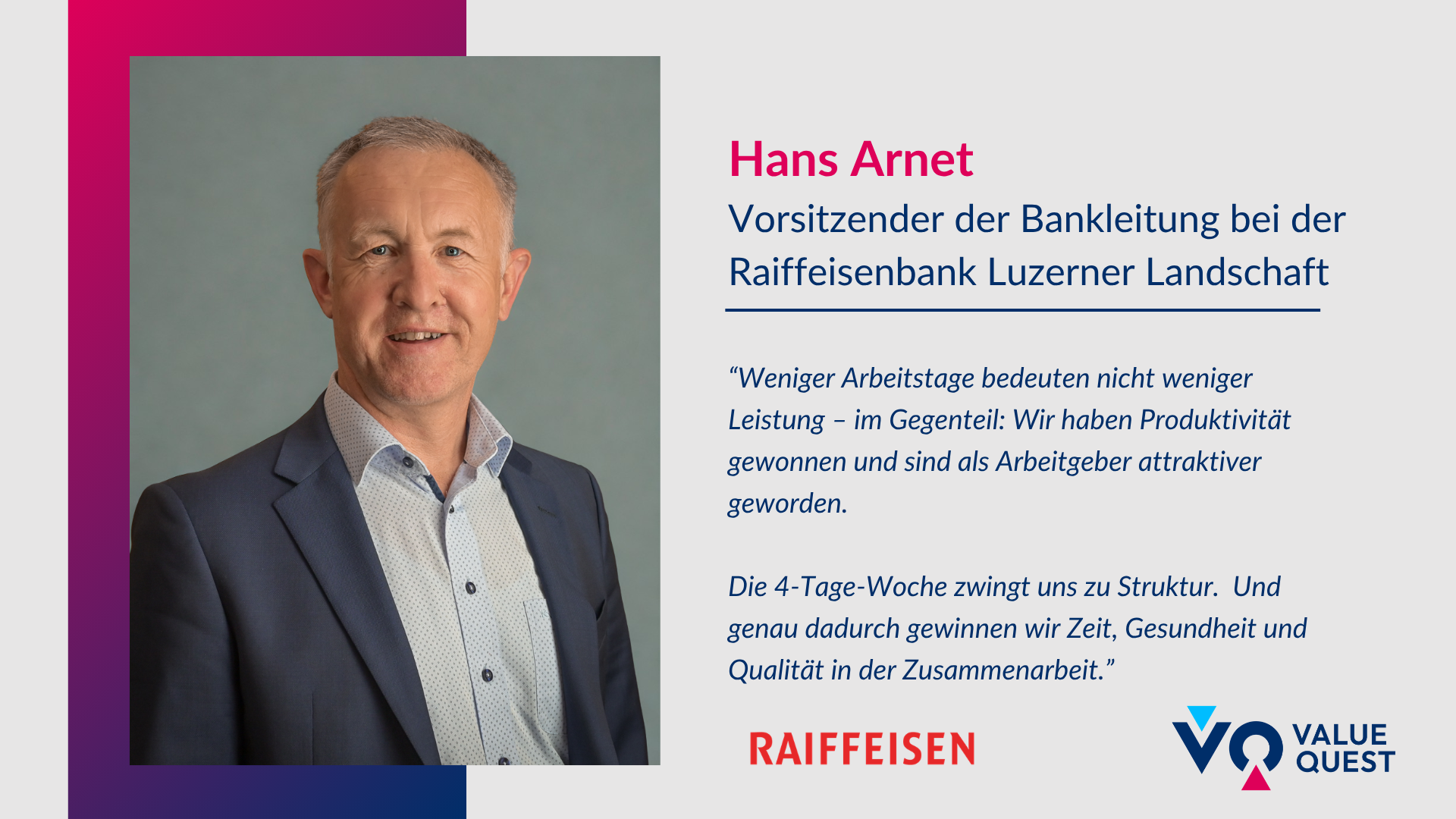
Hans Arnet: The whole thing has a history. At a training course for bank managers, the topic was "Working environments 4.0": How to shape the working world of tomorrow? The special thing was that each manager could take two employees with them. This resulted in a large workshop, similar to a world café: we collected employees' expectations and needs and examined what would be possible.
That was in Thun in 2022, shortly after the coronavirus lockdown. Working from home was already a reality for most people. At the time, I had to make a note of three keywords that seemed particularly important to me: flexible working hours, annualized working hours - and the 4-day week.
The applicant market and staff shortages are forcing a rethink
Kathrin Neumüller: So the idea was already there back then?
Hans Arnet: Exactly. And it never let go of me. We'd had a problem for some time: there were hardly any applications for vacancies. In some cases, we had to wait six months before we could hire anyone at all. We still haven't found a corporate client advisor. We had to improvise internally.
Kathrin Neumüller: When did that become a reality?
Hans Arnet: A colleague from the Appenzell hinterland was the first to try a 4-day week, together with Raiffeisenbank Surselva. A year later, they presented their evaluation after a six-month pilot. These results convinced me.
Shortly afterwards, we decided in a bank management workshop that we also wanted to try out the 4-day week. We presented the Board of Directors with a proposal for a pilot phase from January 2025, which was specifically planned and professionally supported. We were able to recruit a former employee to take on the project management.
📌 Definition 4-day week
The 4-day week is a working time model in which regular working hours are spread over four working days instead of five. There are two approaches:
-
Compression of working hours: The previous weekly working time (e.g. 40 or 42.5 hours) is divided into four longer working days.
-
Reduction in working hours. The weekly working hours are actually reduced (e.g. to 36-38 hours), which means that employees work fewer hours while their salary remains the same or is slightly reduced. At Raiffeisenbank Luzern Landschaft Nordwest, for example, working hours were reduced by 10%.
The goals of the 4-day week are higher employee motivation and productivity, better health, increased employer attractiveness and an improved work-life balance.
Studies from Germany and Switzerland show that companies often achieve more satisfied staff, less sickness absence and greater retention of skilled workers through the 4-day week.
Not all 4-day weeks are the same
Kathrin Neumüller: There are two models: either you squeeze the previous 42.5 hours into four days, or you actually reduce your working hours. Which model did you choose?
Hans Arnet: We have reduced the working week by ten percent to 38 hours. If you work more than 90 percent, you spread these 38 hours over four days. This results in 9.5 hours of target time per day.
And that applies to everyone. Part-time employees benefit accordingly: if you work 80%, you work around 32 hours, i.e. eight hours a day.
Kathrin Neumüller: In other words, your working hours were generally reduced and adjusted by ten percent. So you could say that you have chosen a middle way between the Irish and Belgian models?
Hans Arnet: Exactly.
What really motivates employees
Kathrin Neumüller: 9.5 hours a day. That sounds like a long working day. How did the employees react?
Hans Arnet: In the beginning, that was indeed the biggest concern for full-time employees. But the prospect of an extra day off weighed more heavily. So they said: "Let's see how it feels and then we'll see."
Today, six months later and after three surveys - a baseline survey in December, an initial survey in March and a second survey in May - the picture is clear: Only very few employees still find the 9.5 hours stressful. Specifically, perhaps one or two people.
Kathrin Neumüller: So it's mainly a question of getting used to it?
Hans Arnet: And the workload. If you're busy, you hardly notice whether you've worked 9.5 or even 10 hours.
Perhaps as an addendum: we actually wanted to start last year. But we came to the conclusion that we were not yet mature enough. The Raiffeisen banks in Appenzell and Surselva were already further along in terms of organization and processes. We therefore first trained all employees in time and self-management - three seminars with an external speaker. That was the perfect preparation. Today it is clear that the longer days are no longer a problem because we are better organized.

Graphic: In pre-industrial times, work and leisure were closely intertwined: Families often worked together in the house or in the fields, and work and socializing took place in the same place. With industrialization, a clear spatial and temporal separation of work (factory, office) and leisure (private life) emerged. Digitalization and working from home began to blur the boundaries again. Today, the 4-day week is a modern model that combines clear structures with more free time and at the same time boosts productivity, health and employer attractiveness. At Raiffeisenbank Luzerner Landschaft Nordwest, employees work entirely on site to ensure proximity to customers.
The 4-day week as an advantage for customers
Kathrin Neumüller: Do I understand you correctly: the 4-day week doesn't work without organization?
Hans Arnet: Exactly. Everyone has to structure themselves - from meeting planning to private agendas. Spontaneity is hardly possible anymore. At the same time, however, we gain efficiency, because spontaneity can also be a resource guzzler - something that is often underestimated.
Kathrin Neumüller: That reminds me of Parkinson's Law: work expands exactly to the extent that time is available for it. But you can streamline processes internally. How does that work in customer service? You have to remain flexible there.
Hans Arnet: Interestingly, I'm even more flexible now. I have to do my 9.5 hours and start between 7:00 and 8:00. With my lunch break, I finish between 5:00 and 7:00 pm. In the past, I used to leave at 15:00 or 16:00. Now the day lasts longer and I can use this extra time for consultations.
As a result, we now have a higher frequency of consultation times, even at off-peak times. We've always had a lot of customer meetings early in the morning, but now we also have appointments in the evening after 5 pm. In the past, you had to sacrifice your "free time" for this. Now it happens automatically because the working day is longer - and so we are more flexible.
Kathrin Neumüller: Does that mean you have more evening appointments now than you used to?
Hans Arnet: Exactly. And that's an advantage for customers.
Kathrin Neumüller: That's exciting. I would have thought that employees would see it as a burden if they still have a consultation appointment at 5 pm. But if it's part of the working day, it's probably easier to accept.
Another question: you probably don't have a fixed day off for everyone on Friday, do you?
Hans Arnet: Yes, the day off is fixed. But not for everyone on the same day of the week.
Kathrin Neumüller: How does that work in practice?
Hans Arnet: The decision was made per team. That's why the four-day week works less well for a bank with only ten employees than for a bank of our size. We held workshops, department by department. We discussed it there: How do we organize ourselves? When are our meetings? Who would like to have time off on which day?
The mandate was clear: the teams organize themselves. I don't tell anyone which day is free.
Kathrin Neumüller: Were there any conflicts? I could imagine that everyone would have preferred Friday.
Hans Arnet: That was out of the question. If everyone wanted Friday off, the teams had to come to an agreement. Interestingly, some decided quite differently than I would have thought - even younger people who would have been expected to take Monday or Friday off. But there were no conflicts. Every day has its pros and cons.
Our fixed meeting day is Tuesday. Practically everyone is there then, which makes work much more efficient.
Kathrin Neumüller: So all meetings are concentrated in one day?
Hans Arnet: Exactly. Tuesday is intensive, but clearly structured. Instead of spreading meetings over five days, we do everything in a cascade on one day. And that works very well.
Kathrin Neumüller: Can you personally - and other managers - really make use of the day off? Or does it remain theory because there is always something to do?
Hans Arnet: No, everyone takes the day off. They don't work.
Kathrin Neumüller: Even yourself?
Hans Arnet: Me too. The training courses on time and self-management have helped me, although I'm not a big fan of such courses otherwise. One example: We have agreed that emails will be answered within 24 hours. This removes the pressure to respond immediately.
Kathrin Neumüller: That sounds very liberating.
Hans Arnet: Yes. On Thursday - my day off - I answer the most important e-mails by Friday morning at the latest. Everything else has time. It's also important that we don't communicate the 4-day week to the outside world. Otherwise people will quickly say: "They're never here." The fact is: even on a normal working day, I'm not immediately available if I'm in meetings all day.
Implementing the 4-day week: What it comes down to
Kathrin Neumüller: And on a strategic level? I know it myself: Operationally, structure works, but strategic issues quickly come under pressure. How do you ensure that there is room for this?
Hans Arnet: It's a question of planning. Tuesday is our bank management day. We meet from 1 p.m. to 3 p.m., and once a month we add an "Open Day". Then we reserve the afternoon for strategic topics - usually until 6 or 7 pm. We didn't have anything like that before. With five days, the temptation to postpone strategic issues was greater. Today, they are firmly scheduled.
An example: I don't see my deputy on Mondays. So I discuss important points with him on Friday, before the bank management meeting on Tuesday. We are forced to set clear time frames - and this means that no meeting lasts longer than necessary.
In the past, I wasn't necessarily the most planning-oriented person, but today I have to say that I have gained time thanks to structured planning, despite working a 4-day week.
Kathrin Neumüller: And how did the employees react - in the long term, but also during the pilot phase? Was the feedback mainly positive?
Hans Arnet: You know what? We haven't had a termination notice for a year.
Kathrin Neumüller: Really?
Hans Arnet: Yes. We didn't have to advertise anything. Recently, we were looking for a financial advisor - and had enough applications to make a selection. That used to be unthinkable. We also received applications in the private client advisory area. We are deliberately taking our time there. We are even considering hiring two people "on reserve" because we know that younger people often leave for language courses or further training.
Kathrin Neumüller: And how does the day off work - is it actually observed?
Hans Arnet: Yes. In the first measurement, compliance was 88 percent, in May it was already 94 percent - a high figure. But there is one challenge: the part-time employees.
Kathrin Neumüller: In what way?
Hans Arnet: You don't benefit from an extra day off. Spreading a 50 percent workload over just two days - 19 hours - would be theoretically possible, but not practicable for us. These jobs have to be spread over two and a half days, otherwise there is a lack of presence. Part-time employees initially had the feeling: "We work for the others so that they have time off." This feeling has not completely disappeared.

More motivated and healthier employees thanks to the 4-day week
Kathrin Neumüller: And what about motivation and health?
Hans Arnet: Health values are very high. Motivation is rather low - we still expect changes there. But self-management has improved. And we deliberately don't talk about "work-life balance", but "life balance".
Kathrin Neumüller: What's the difference?
Hans Arnet: In the past, work was work and leisure was leisure. Then came digitalization - and everything got mixed up. Today, we want a clear separation again. Many people struggled with this at first. The question sometimes came up: "What am I supposed to do with my wife all day?" But routines have now been established. Employees who I thought would soon quit are now more balanced. They really do have a day off and can do things that they didn't have time for before.
Kathrin Neumüller: And you yourself?
Hans Arnet: My day off is Thursday. Even if the weather is bad, I do everything that would otherwise be left on Saturday. So I have a really free weekend.
Kathrin Neumüller: That sounds like a big win.
Hans Arnet: Yes. Our productivity already increased in the first six months. No losses, on the contrary: greater focus, more attractive as an employer. Of course it remains a process, but we have a common basis.
Kathrin Neumüller: And what about working from home?
Hans Arnet: A few miss it, but I've always said: I don't see the productivity in a customer advisor working from home - it was often more "home" than "office". Now they have their "home" with the 4-day week.
Kathrin Neumüller: I see.
Hans Arnet: Part-time employees are also adapting: fewer breaks, more structure. During a presentation to colleagues, one of them said: "We also have a 38-hour week - but with lots of breaks." My reply: "We have a whole day off for that."
Hans Arnet: Our goal was to work less and be healthier. And we have achieved that. Employees move more and are out in the fresh air. You can see that in their faces.
Kathrin Neumüller: Sounds great.
Hans Arnet: We are extending the pilot phase until the end of the year. In August, we will submit a proposal to the Board of Directors to definitively introduce the 4-day week from January 2026. What interests me: What effect will it have in three or five years' time? Will it hold? Or will it wear out?
Kathrin Neumüller: You currently have weekly working hours. Would you like to have annual working hours?
Hans Arnet: Yes. There's a lot going on in investment consulting at the beginning of the year, less in the summer and more again at the end of the year. I would like to give employees more flexibility. But presence is still necessary - nobody can go on vacation for two months at a time.
Kathrin Neumüller: So the 4-day week remains the model of the future?
Hans Arnet: I think so. 4.5 days or alternating models would be possible, but the team has to work. I reject a 38-hour week spread over five days. With 9.5-hour days, we can also achieve consultation times in the evening - exactly when many customers have time.
Kathrin Neumüller: Thank you very much for the interview, Mr. Arnet.
Hans Arnet: Thank you very much.
Article published on August 27, 2025
About Dr. Kathrin Neumüller

Dr. oec. HSG Kathrin Neumüller is Co-Managing Director at ValueQuest and an expert in employee inspiration and empowerment. She also teaches strategic management in the MBA program at the ZHAW. She holds a doctorate from the University of St. Gallen (HSG) and studied at the University of Cambridge. Learn more about Kathrin
Inspired? Then share this post via your favorite platform.
Other articles that might interest you ...

AI in the Swiss Insurance Market: What Insurers Can Learn from the Results
October 1, 2026
Reading time: 4 min
Artificial intelligence is not universally accepted in the Swiss insurance market. As a study by ValueQuest shows, customers’ openness to AI depends heavily on how it is used.

AI in the Swiss Insurance Market: Between Acceptance and Skepticism
September 28, 2026
Reading time: 5 min
For many Swiss people, artificial intelligence has become an integral part of everyday life. However, the situation is different when it comes to insurance companies.

Top Employer: Raiffeisenbank Glarnerland Impresses with Strong Leadership
September 21, 2026
Reading time: 2 min
ValueQuest recently had the honor of presenting the “Excellence@Work Award” to Raiffeisenbank Glarnerland. We extend our heartfelt congratulations.
Top Swiss Employers: GastroSocial
September 9, 2026
Reading time: 3 min
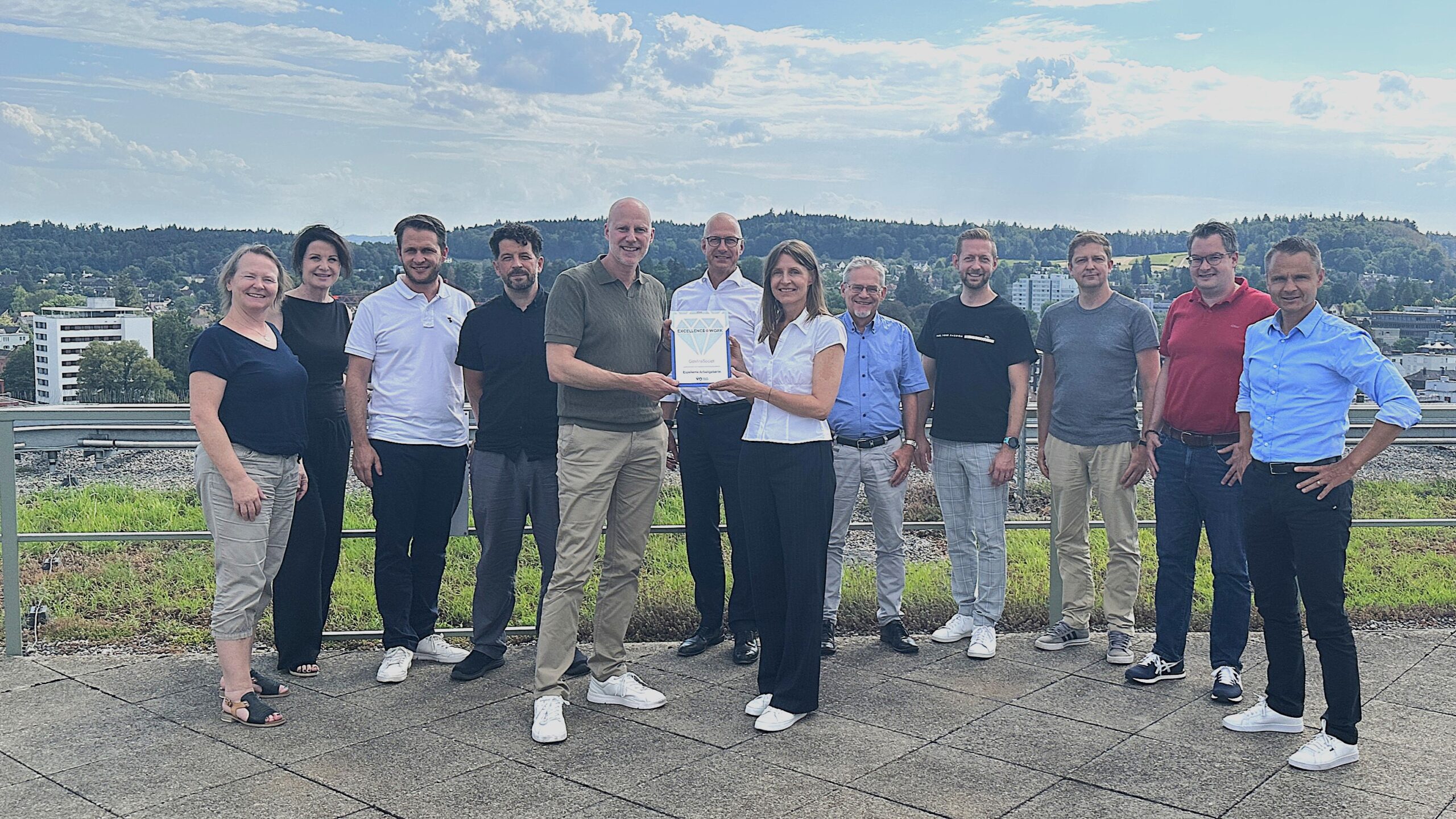
GastroSocial has received the 2026 Excellence@Work Award from ValueQuest. With a response rate of 96 percent, a motivation score of 84, and 87 percent of employees serving as brand ambassadors, the company demonstrates a strong employer culture.

Employee Survey: Raiffeisenbank Möhlin Achieves Excellent Results
August 31, 2026
Reading time: 3 min
Raiffeisenbank Möhlin is one of Switzerland's top employers and is receiving our Excellence@Work Award in recognition of this achievement. Congratulations!

Employee Surveys in Switzerland: Find Providers & Tools
August 30, 2026
Reading time: 6 min
Employee Survey in Switzerland: How Do You Find the Right Employee Survey Provider? What Really Matters When It Comes to Anonymity, Tools, Questionnaires, and Analysis.

360-Degree Feedback Questionnaire: Sample, Template, and Sample Questions
August 21, 2026
Reading time: 7 min
Table of Contents A 360-degree feedback process is only as good as its questionnaire. The questionnaire is at the heart of the entire process. It determines whether...
Employee Survey: The CAMPUS SURSEE Foundation Is Among Switzerland's Best Employers
August 5, 2026
Reading time: 2 min
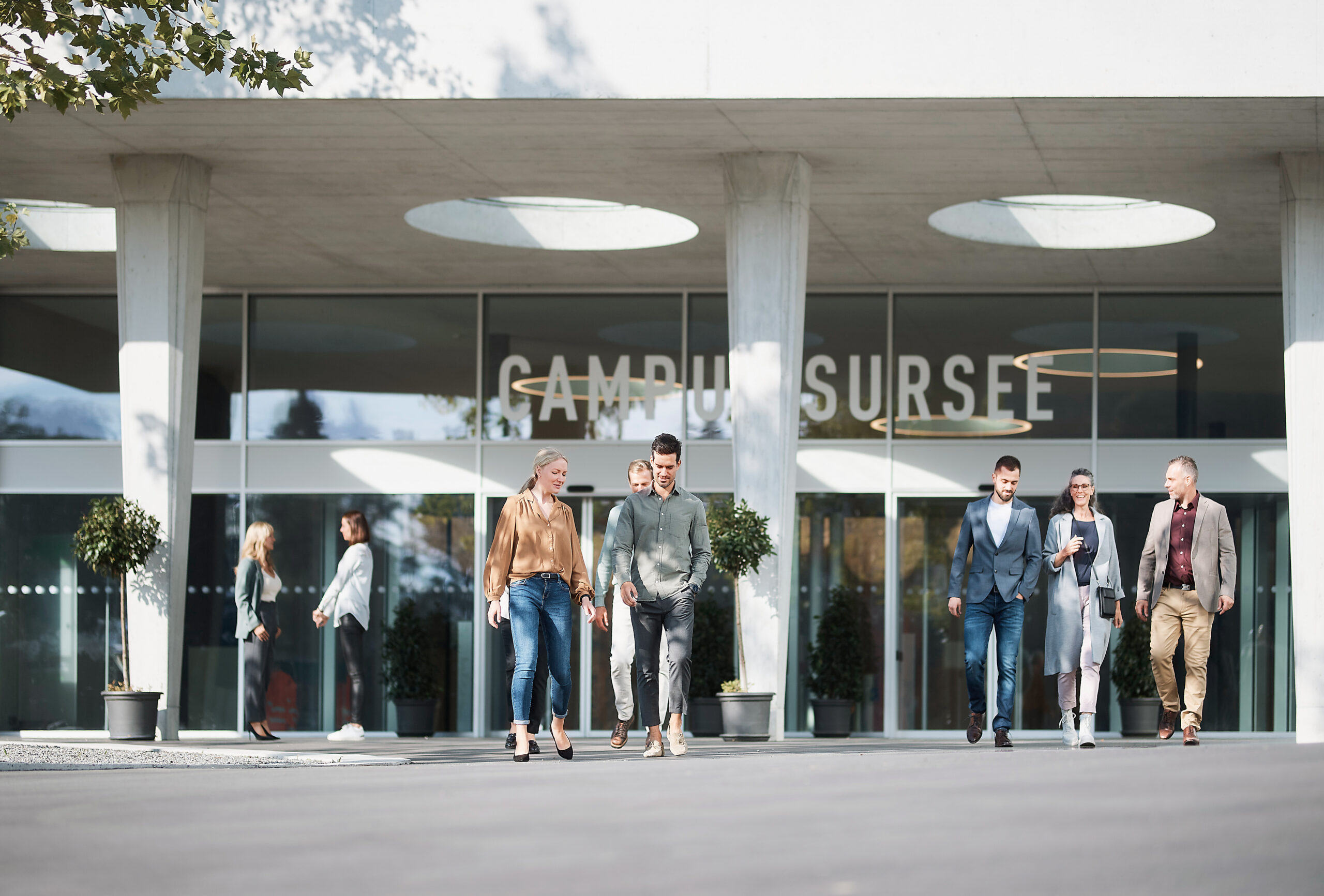
ValueQuest honors particularly attractive employers in Switzerland with the Excellence@Work Award. We recently had the pleasure of presenting the award to the CAMPUS SURSEE Foundation.
Raiffeisenbank Regio Arbon, a Top Employer: Personal Responsibility as Part of a Strong Corporate Culture
July 7, 2026
Reading time: 2 min
ValueQuest honors particularly attractive employers in Switzerland with the Excellence@Work Award. We recently had the pleasure of presenting the award to Raiffeisenbank Regio Arbon.