Feedback is important – but it's often perceived as an attack rather than an opportunity for further development. Why is this, and what can we do about it? This article explores the psychological factors that play a role and what helps make feedback effective.
Feedback helps us develop – both professionally and personally. Yet it often leads to frustration rather than progress. Companies and managers invest in feedback processes, but the results fall short of expectations. Why do many people take feedback personally, even when it's meant to be constructive? Why is it often difficult to give honest feedback? The answers lie in psychology.
Why is getting feedback so difficult?
Our brain is programmed to avoid danger – a survival instinct that has accompanied us since the Stone Age (Damasio, 1998). Back then, it was important to react quickly: At the sight of a saber-toothed tiger, hesitation was not an option – those who instinctively fled had a better chance of survival. This automatic protective program is still active today. Our brain often interprets negative feedback as an attack, which triggers stress reactions. Instead of using feedback as a constructive stimulus, we go into fight-or-flight mode – we defend ourselves or withdraw. Many people fend off feedback or look for reasons not to take it seriously. In doing so, they miss the opportunity to learn from it.
Our brain plays tricks on us – cognitive distortions
We rarely receive feedback objectively – our brain plays tricks on us. Daniel Kahneman, Nobel laureate and co-founder of behavioral economics, shows that our thinking is characterized by numerous cognitive biases. These unconscious thought patterns often arise from so-called System 1 thinking – a fast and relatively effortless way of processing information, but one that is prone to error (Kahneman, 2012). Cognitive biases arise because our brain often processes information in a simplified manner. Instead of analytically thinking through every decision, our brain resorts to mental "shortcuts" (so-called heuristics) to react quickly. While this makes our everyday lives easier, it can get in the way, especially when it comes to feedback. Below, we look at three typical thinking errors that influence our perception of feedback.
Misconception 1: Defending our positive self-image
Imagine you're presenting a new strategy to a management team. The reactions are overwhelmingly positive: Your arguments are praised, your presentation is considered convincing. You're proud—and rightly so, because it shows that you've done a good job.
Now, a different situation: During a later presentation, you receive critical feedback. Some participants question your ideas, and the discussion becomes heated. Your first thought? "They must have not prepared properly" or "The framework was unclear."
Why do we react this way? One of the reasons is the self-serving bias. We tend to attribute successes to our own abilities, while blaming failures on external circumstances. This bias was studied by Fritz Heider (1958) and later by Miller and Ross (1975). In everyday work, it leads employees to perceive positive feedback as confirmation of their own competence, while critical feedback is often rejected or rationalized.
🎯 Our tips for the feedback recipient:
- Conscious reflection: After receiving critical feedback, take a moment to think about which aspects you were actually able to influence. Instead of immediately looking for external causes, ask yourself: What could I have done differently?
- Change of perspective: Imagine someone else had experienced the same situation. Would you make the same arguments for this person? Or would you advise them to see the feedback as a learning opportunity?
- Split the feedback: Separate the factual content from the emotional reaction. Critical feedback often feels like a personal judgment, but usually only refers to individual aspects of performance.
Misconception 2: Blaming our failures on external circumstances
A team leader notices that a member of staff is frequently late to meetings. Their first thought: "They're just unreliable." They may even wonder if this member of staff is truly suited to larger projects. Now let's reverse the situation: The team leader himself arrives late once. Their first thought? "The meeting just ran longer than expected" or "I was suddenly held up."
Why this difference in scale? This is where the fundamental attribution error (Ross, 1977) comes into play. We often attribute the behavior of others to their personality, while we explain our own behavior with external circumstances. In practice, this means that a manager interprets a person's poor performance as a sign of a lack of commitment, while the person concerned blames external factors such as unclear targets or a lack of resources. This distortion means that the feedback is often harsher than we would like to hear ourselves.
💬 Our tips for feedback providers:
- Separate facts from interpretations: Observe the behavior without immediately judging it. "The meeting started at 10:00 a.m., you arrived at 10:10 a.m." is a non-judgmental statement. In contrast, "You are unreliable" is an interpretation.
- Ask open questions: Instead of making hasty judgments, it helps to formulate feedback curiously: "I've noticed that you've been arriving late more often recently - are there any reasons for this?" This creates space for an explanation and is much more likely to lead to a constructive conversation.
- Turn feedback around: Would you give yourself or another manager the same feedback? Or would you ask about the background and causes? A change of perspective can help to give fair and objective feedback.
Misconception 3: Overestimating negative information.
You receive an email from your supervisor with the subject line: "Feedback on your last presentation." Even before you open the message, you feel a lump in your throat. You immediately remember the time a number wasn't right and your supervisor pointed it out to you. Reading the email, you notice that the feedback is mostly positive. Only one small suggestion for improvement is made. But what sticks in your mind? That's right: that one critical comment.
This is due to the negativity bias (Rozin and Royzman, 2001). Our brain gives negative information more weight than positive. If feedback is perceived as criticism, we often react defensively: either with fight (justification, counterattack) or flight (internal resignation, withdrawal from the discussion). This mindset, which originally ensured our survival by giving greater weight to negative emotions like fear, now makes it difficult to see criticism as a valuable stimulus for further development.
🎯 Our tips for feedback providers and recipients:
- Consciously balance positive and negative feedback: When you receive feedback, don't just make a note of the criticism, but also the positive points. Our brains often unconsciously block out praise. A simple technique for feedback providers to counteract negativity bias is the "three-to-one principle": three positive points for every critical one.
- Time before reacting: Emotional stress levels often rise immediately after critical feedback. Give yourself time before you react. Instead of immediately formulating an explanation or defense, it helps to consciously take a deep breath and let the feedback sink in first.
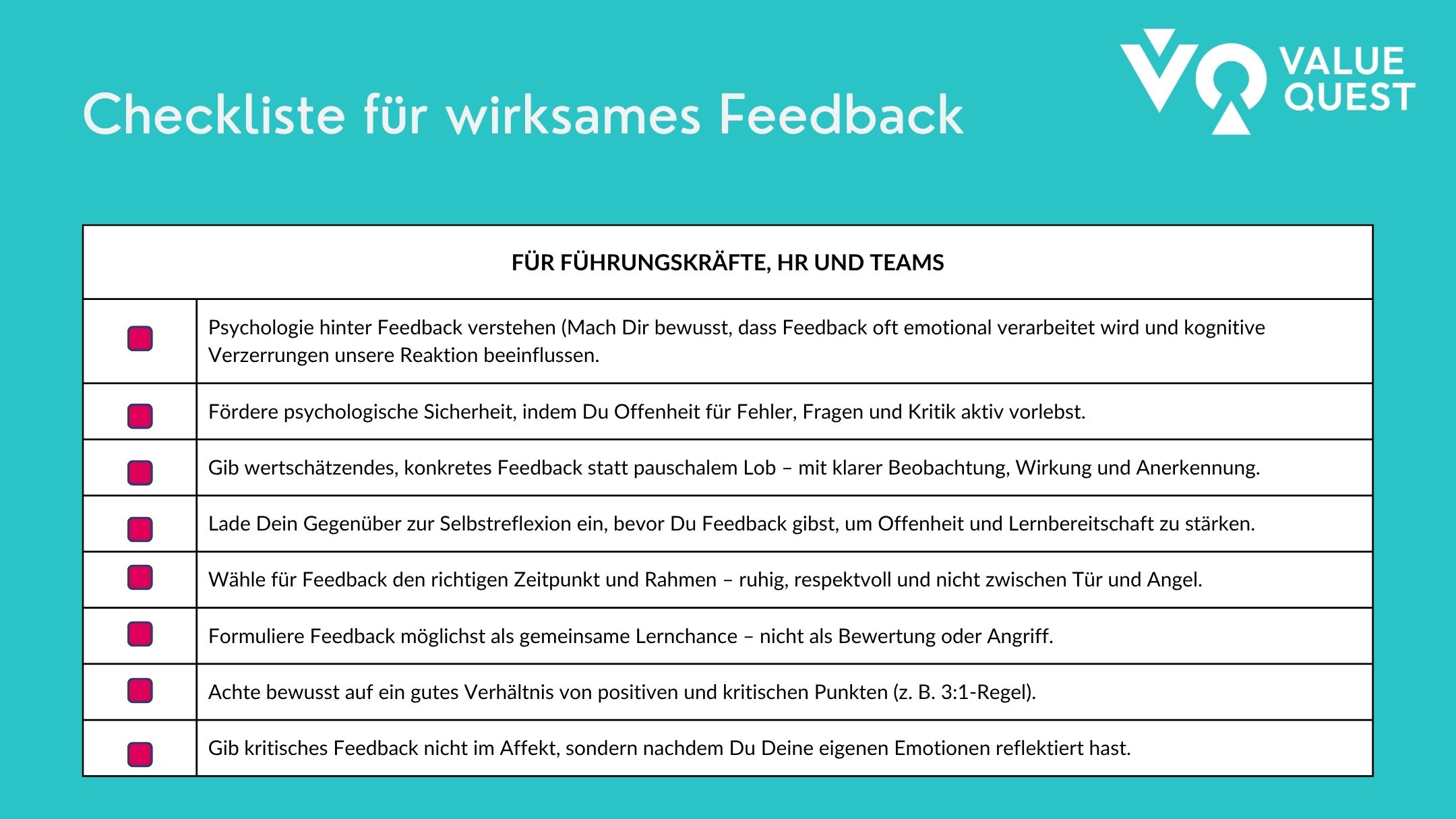
The art of good feedback - What managers should consider
Cognitive biases often influence the way we give and receive feedback without our being aware of it. The biggest mistake is believing we are free from them. This so-called bias blind spot (Pronin et al., 2002) describes our tendency to easily recognize biases in others while considering our own thinking to be largely objective.
Managers, in particular, should be aware of this: Those who believe they are making completely unbiased judgments are particularly susceptible to blind spots. However, it's not enough to simply question their own biases – those of their employees also play a role. Only those who consider their own thinking and that of their employees can provide constructive feedback and encourage employees to actively provide feedback themselves. The following five tips show how managers can create an open feedback culture within their team and structure feedback in such a way that everyone uses it as an opportunity for further development.
Tip #1: Create Psychological Safety
Have you ever sat in a meeting and wondered what a certain term means? You look around, but no one asks the question. So you remain silent – for fear of appearing unprofessional. This is psychological (in)security. No one wants to be perceived as incompetent, pushy, or negative in the workplace. Therefore, many – usually unconsciously – rely on strategies to make the impression they make on others as positive as possible (impression management). The problem: learning opportunities are lost. Mistakes go undetected, potential for innovation goes unspoken, and employees contribute less actively to the company's further development.
📌 Infobox: Psychological safety
Psychological safety means that it is not only accepted, but expected in a team. expected to openly address concerns, questions, ideas and mistakes - without fear of negative consequences.
According to Amy Edmondson (1999), psychological safety is crucial for employees to feel confident in giving and receiving honest feedback. Psychological safety means that team members are not afraid of negative consequences for admitting mistakes or raising concerns. In an environment where mistakes are viewed as part of the learning process, feedback is not a threat but a valuable tool for further development. Leaders play a key role in creating a climate in which employees feel confident in speaking openly.
Concrete measures for psychological safety
A manager who shows that he or she learns from mistakes signals to the team that mistakes are not a flaw, but a normal part of the work process.
Feedback should not be seen as an evaluation, but as an opportunity for further development.
Meetings such as retrospectives or "lessons learned" sessions help to openly discuss successes and opportunities for improvement - without fear of negative consequences.
The above measures not only help build trust within the team, but also counteract a common thinking bias: the self-serving bias. Those who feel confident can acknowledge mistakes as part of the learning process instead of blaming them on external circumstances.
Tip #2: Give appreciative feedback, not just praise
"Companies don't give enough praise." This statement is often heard. But it's not just about giving praise more often; it's also about providing the right kind of recognition. Employees don't just want to hear the occasional nice remark; they want their performance to be truly recognized. They expect appreciative, substantive feedback that promotes their professional development. Studies show that 32% of employees complain about a lack of appreciation (DGB Good Work Index, 2019). Furthermore, lack of recognition is the second most common reason for leaving a job (Manpower Group, 2017).
Positive feedback and praise are not the same. Praise is usually vague and without a clear explanation ("You did a great job!" or "Good work"). Appreciative feedback, on the other hand, is concrete: It describes an observed behavior, the resulting positive effects, and expresses targeted recognition. While genuine feedback shows that the feedback provider has engaged with the person and their work, praise often remains general and superficial—in some cases, it can even seem condescending. Moreover, praise quickly wears thin if used excessively.
Tip #3: Use storytelling to properly build constructive feedback
Criticism should always be expressed as part of constructive feedback. It's not enough to simply point out deficiencies – it's crucial that feedback also highlights concrete development opportunities. Good constructive feedback typically includes the following four points:
🌟 Key elements of positive feedback
Employees need targeted feedback that not only expresses recognition of their work, but also shows why their performance is valuable.
What exactly has the person done or achieved?
z.B.: "The presentation was logically organized and clearly structured."
What positive effects did this behavior have?
z.B.: "The visualizations in particular helped to underpin the argumentation. That convinced the team."
An explicit appreciation of performance.
z.B.: "Thank you very much for your commitment."
To provide constructive feedback as gently as possible and to reduce resistance, managers can use the sandwich method (Ash, 1984). This method involves embedding the constructive feedback within two positive feedback statements. It begins with a positive introduction ("I liked the fact that your presentation..."), followed by the observation and the suggestion for improvement, and ends with a motivating statement ("Your project reports are always structured. I am convinced that you can also incorporate this structure into your presentations"). However, the sandwich method should only be used in specific situations and requires a certain degree of communicative skill, as otherwise it can quickly seem unnatural and lose its positive effect.
Despite all due care, critical feedback can initially trigger resistance. This is where the SARA model (Shock, Anger, Resistance, Acceptance) comes in. It describes the typical phases people go through when receiving critical feedback – from initial shock, through anger and resistance, to acceptance (e.g., Kern, 2024). The model helps leaders better understand and manage the emotional reactions of the feedback recipient. By formulating feedback in an appreciative manner, giving the other person space for their reaction, and asking targeted, open questions, they encourage reflection and facilitate the transition to acceptance. This way, constructive feedback can not only be better processed but also used as a genuine stimulus for development.
Tip #4: Encourage self-reflection among your employees
An effective method for making feedback more constructive is to first ask the feedback recipient to assess their own performance ("How did you perceive your performance?"). This promotes self-reflection, increases openness to constructive feedback, and strengthens identification with the feedback. Furthermore, a realistic self-assessment helps reduce the self-serving bias described above – the natural tendency to attribute successes to one's own abilities while blaming failures on external circumstances.
A particularly effective concept for promoting self-reflection is the Seven Pillars of Resilience (Nuber, 2005; Reivich and Shatté, 2003), which provides strategies for strengthening psychological resilience. Three central pillars are particularly well-suited to dealing with feedback:
Central pillars for promoting self-reflection
Those who believe in their own ability to develop further are more likely to perceive feedback as an opportunity and not remain stuck in a defensive attitude. Managers can support this by specifically highlighting successes and progress.
Criticism is not always pleasant, but it is necessary. Employees who accept that not all feedback is pleasant or that feedback can sometimes be challenging deal with it more confidently.
Instead of getting lost in negative emotions, it helps to focus on improvement. Those who immediately consider how they can implement feedback will benefit more in the long term.
Tip #5: Consider timing and context
Feedback isn't just a matter of words, but also of timing. It shouldn't come too late, which would otherwise lose its relevance, nor should it be given too late, which would cause more harm than good.
A calm, appreciative environment is crucial, especially when dealing with critical issues – ideally without anyone listening in the background. Giving feedback in passing or inserting it between meetings risks it not being properly received. Shortly before the weekend or directly after a stressful meeting are also unfavorable times for constructive feedback. It is therefore a good idea to actively announce a feedback meeting so that the person you are giving can mentally prepare for it. Announcements such as, "Let's sit down together later; I have a few thoughts on your presentation" help to reduce resistance. Restraint can also be wiser for the person giving feedback in emotionally charged situations. For example, if you are annoyed with a team member directly after a difficult meeting, you should not react immediately. A moment of reflection helps to sort out emotions and formulate criticism more constructively.
However, collecting and postponing feedback for too long can also be problematic. Holding back criticism for too long risks building frustration and overwhelming the recipient with suggestions for improvement in a single conversation. Small, continuous prompts, delivered in a timely and targeted manner, are better than a long list of potential improvements that must be addressed all at once.
Sources
- Ash, M.K. (1984). Mary Kay on People Management. New York: Grand Central Pub.
- Damasio, AR (1998). Emotion in the perspective of an integrated nervous system. Brain Research Reviews , 26 (2-3), 83-86.
- Edmondson, A. (1999). Psychological safety and learning behavior in work teams. Administrative Science Quarterly , 44, 350–383.
- Heider, F. (1958). The psychology of interpersonal relationships. New York: Wiley.
- Kahneman, D. (2012). Thinking, fast and slow. New York: Penguin Books Ltd.
- Kern, S. (2024). Empathy–Feedback & Communication–Resilience–Reflection. In The Transformation Management Office–Deep Dive: Implementing Agile and Digital Transformations with a Hands-On Mentality (pp. 81–92). Berlin, Heidelberg: Springer Berlin Heidelberg.
- Miller, D.T., & Ross, M. (1975). Self-serving biases in the attribution of causality: Fact or fiction? Psychological Bulletin, 82(2), 213-225.
- Nuber, U. (2005). Resilience: Immune to Fate? Psychology Today, 9 (2005).
- Pronin, E., Lin, DY, & Ross, L. (2002). The bias blind spot: Perceptions of bias in self versus others. Personality and Social Psychology Bulletin , 28 (3), 369-381.
- Reivich, K., & Shatté, A. (2003). The Resilience Factor: 7 Keys to Finding Your Inner Strength and Overcoming Life's Hurdles. New York: Broadway Books.
- Ross, L. (1977). The intuitive psychologist and his shortcomings: Distortions in the attribution process. In L. Berkowitz (Ed.), Advances in Experimental Social Psychology (Vol. 10, pp. 173–220). New York: Academic Press.
- Rozin, P., & Royzman, E. B. (2001). Negativity bias, negativity dominance, and contagion. Personality and Social Psychology Review, 5(4), 296–320
| Prof. (FH) Dr. oec. HSG Kristina Harthaller (nee Kleinlercher) is a professor of Omnichannel Marketing & Sales at MCI Internationale Hochschule GmbH. Previously, she worked as a project manager and head of the Omnichannel & Customer Experience Management Competence Center at the Research Center for Retail Management at the University of St.Gallen. Her areas of expertise include consumer behavior along the customer journey, omnichannel management, and service management, with a particular focus on employee inspiration.
Contact: kristina.harthaller@mci.edu . Kathrin Neumüller, PhD, is an expert in the field of employee empowerment and inspiration and a project manager at the Swiss market research institute ValueQuest. She lectures at the Zurich University of Applied Sciences (ZHAW). She is also a keynote speaker and author of specialist books on leadership, employee empowerment, and inspiration. Her latest book, "Inspiring Employees," was published in February 2024 (image box).
Contact: neumueller@valuequest.ch |
Article published on May 29, 2025
About Dr. Kathrin Neumüller

Dr. oec. HSG Kathrin Neumüller is Co-Managing Director at ValueQuest and an expert in employee inspiration and empowerment. She also teaches strategic management in the MBA program at the ZHAW. She holds a doctorate from the University of St. Gallen (HSG) and studied at the University of Cambridge. Learn more about Kathrin
Inspired? Then share this post via your favorite platform.
Other articles that might interest you ...

AI in the Swiss Insurance Market: What Insurers Can Learn from the Results
October 1, 2026
Reading time: 4 min
Artificial intelligence is not universally accepted in the Swiss insurance market. As a study by ValueQuest shows, customers’ openness to AI depends heavily on how it is used.

AI in the Swiss Insurance Market: Between Acceptance and Skepticism
September 28, 2026
Reading time: 5 min
For many Swiss people, artificial intelligence has become an integral part of everyday life. However, the situation is different when it comes to insurance companies.

Top Employer: Raiffeisenbank Glarnerland Impresses with Strong Leadership
September 21, 2026
Reading time: 2 min
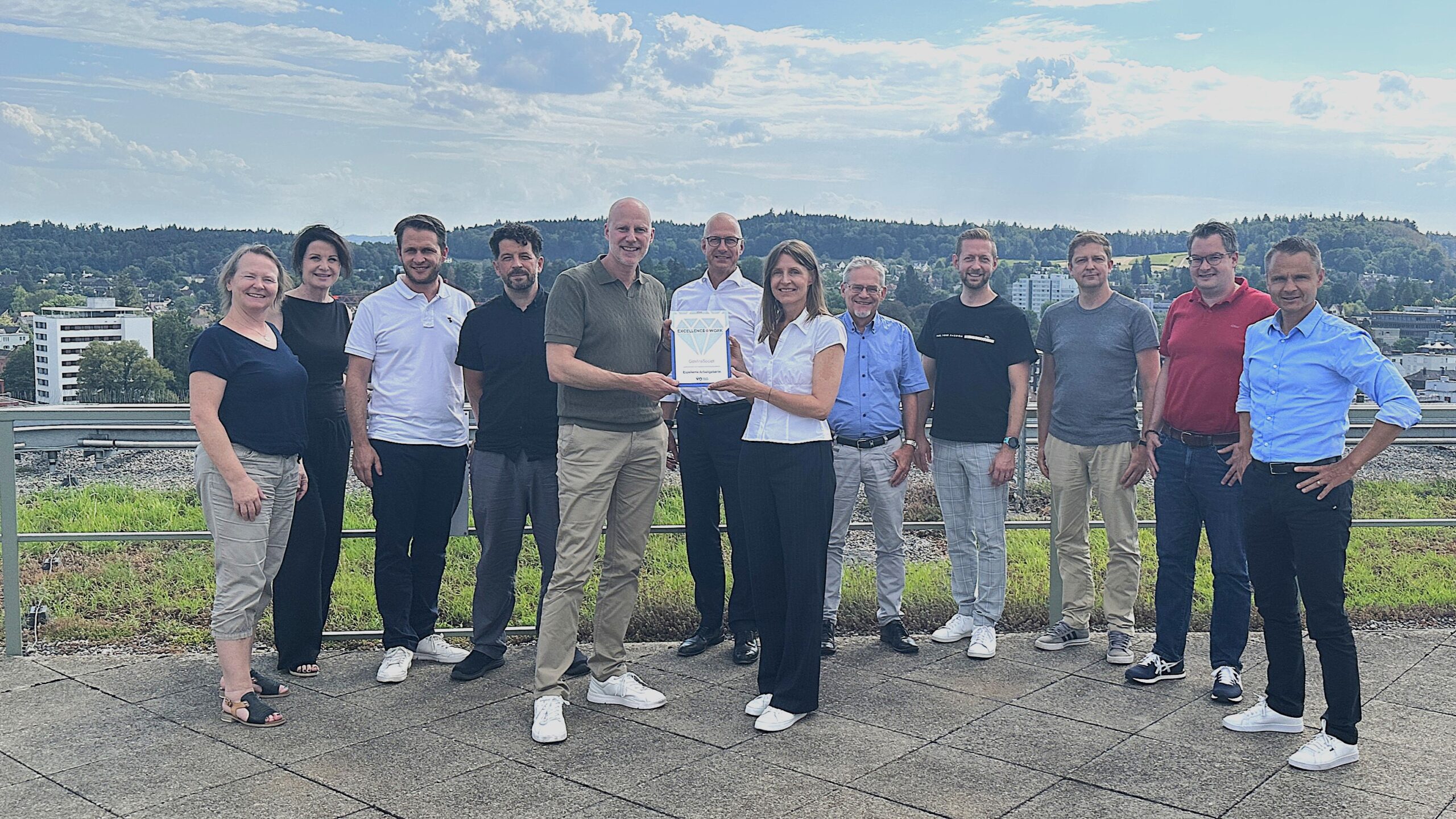
ValueQuest recently had the honor of presenting the “Excellence@Work Award” to Raiffeisenbank Glarnerland. We extend our heartfelt congratulations.
Top Swiss Employers: GastroSocial
September 9, 2026
Reading time: 3 min
GastroSocial has received the 2026 Excellence@Work Award from ValueQuest. With a response rate of 96 percent, a motivation score of 84, and 87 percent of employees serving as brand ambassadors, the company demonstrates a strong employer culture.

Employee Survey: Raiffeisenbank Möhlin Achieves Excellent Results
August 31, 2026
Reading time: 3 min
Raiffeisenbank Möhlin is one of Switzerland's top employers and is receiving our Excellence@Work Award in recognition of this achievement. Congratulations!

Employee Surveys in Switzerland: Find Providers & Tools
August 30, 2026
Reading time: 6 min
Employee Survey in Switzerland: How Do You Find the Right Employee Survey Provider? What Really Matters When It Comes to Anonymity, Tools, Questionnaires, and Analysis.

360-Degree Feedback Questionnaire: Sample, Template, and Sample Questions
August 21, 2026
Reading time: 7 min
Table of Contents A 360-degree feedback process is only as good as its questionnaire. The questionnaire is at the heart of the entire process. It determines whether...

Employee Survey: The CAMPUS SURSEE Foundation Is Among Switzerland's Best Employers
August 5, 2026
Reading time: 2 min
ValueQuest honors particularly attractive employers in Switzerland with the Excellence@Work Award. We recently had the pleasure of presenting the award to the CAMPUS SURSEE Foundation.
Raiffeisenbank Regio Arbon, a Top Employer: Personal Responsibility as Part of a Strong Corporate Culture
July 7, 2026
Reading time: 2 min
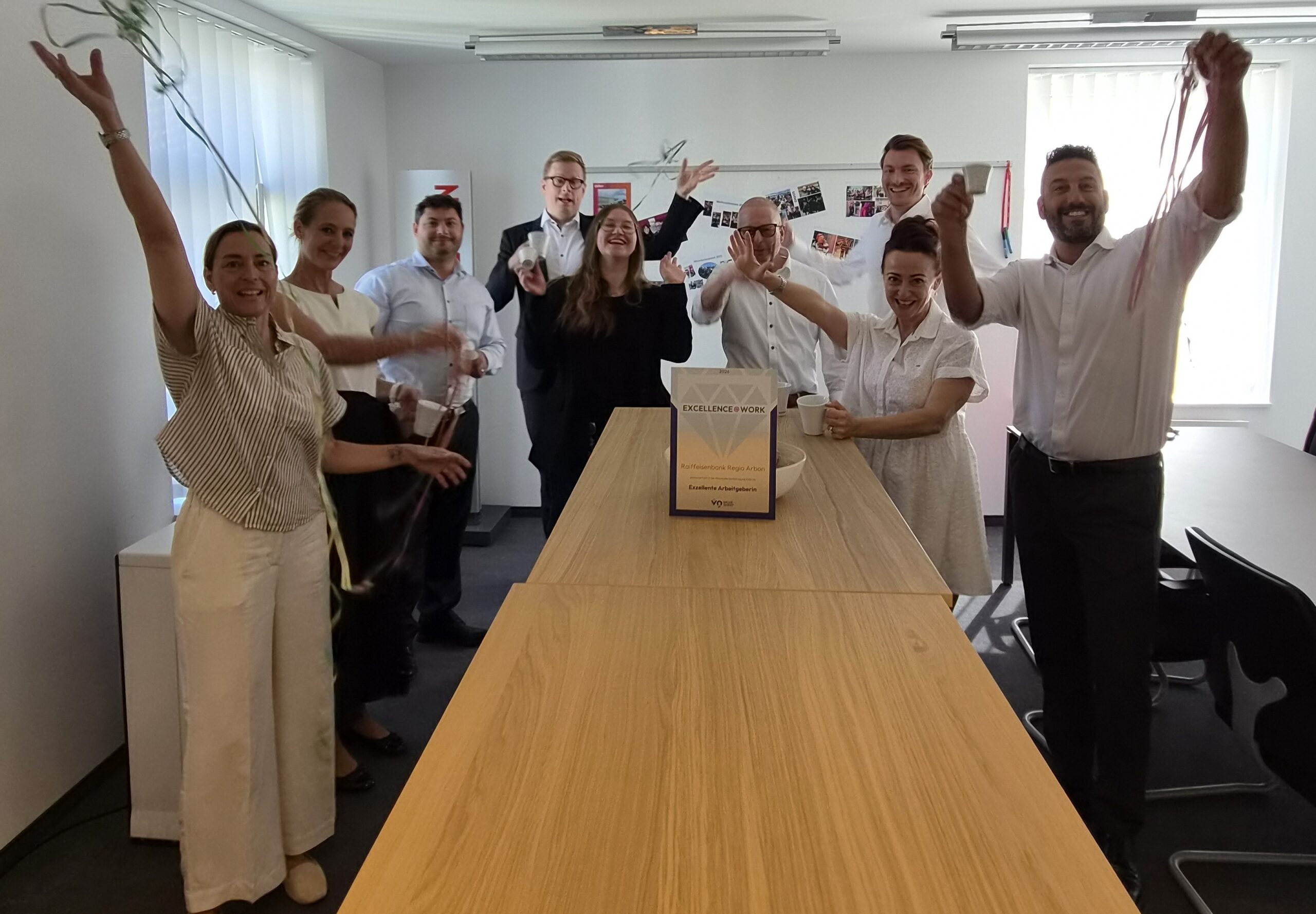
ValueQuest honors particularly attractive employers in Switzerland with the Excellence@Work Award. We recently had the pleasure of presenting the award to Raiffeisenbank Regio Arbon.