Table of contents
What the response rate really says: More than just a number
A high response rate in employee surveys is no coincidence. It is a strong indication of a healthy feedback culture and your employees' confidence in the survey process. In Switzerland, the average response rate is between 75 and 85 percent. At ValueQuest, we aim for a target value of 80 percent, especially for office employees with PC access. However, the benchmarks vary depending on the size of the company and the sector:
- White-collar employees: Participation rates of 80-90% are common.
- Manufacturing companies: In companies with many employees in production or in the field, the response rates are often lower (around 60 %), as there is no direct access to a PC.
A high level of participation not only signals the interest and commitment of your workforce, but also their trust in the company management. It shows that your employees believe that their feedback will be taken seriously and will lead to positive changes.
Quiet Quitting: Those who keep quiet have often already quit inside
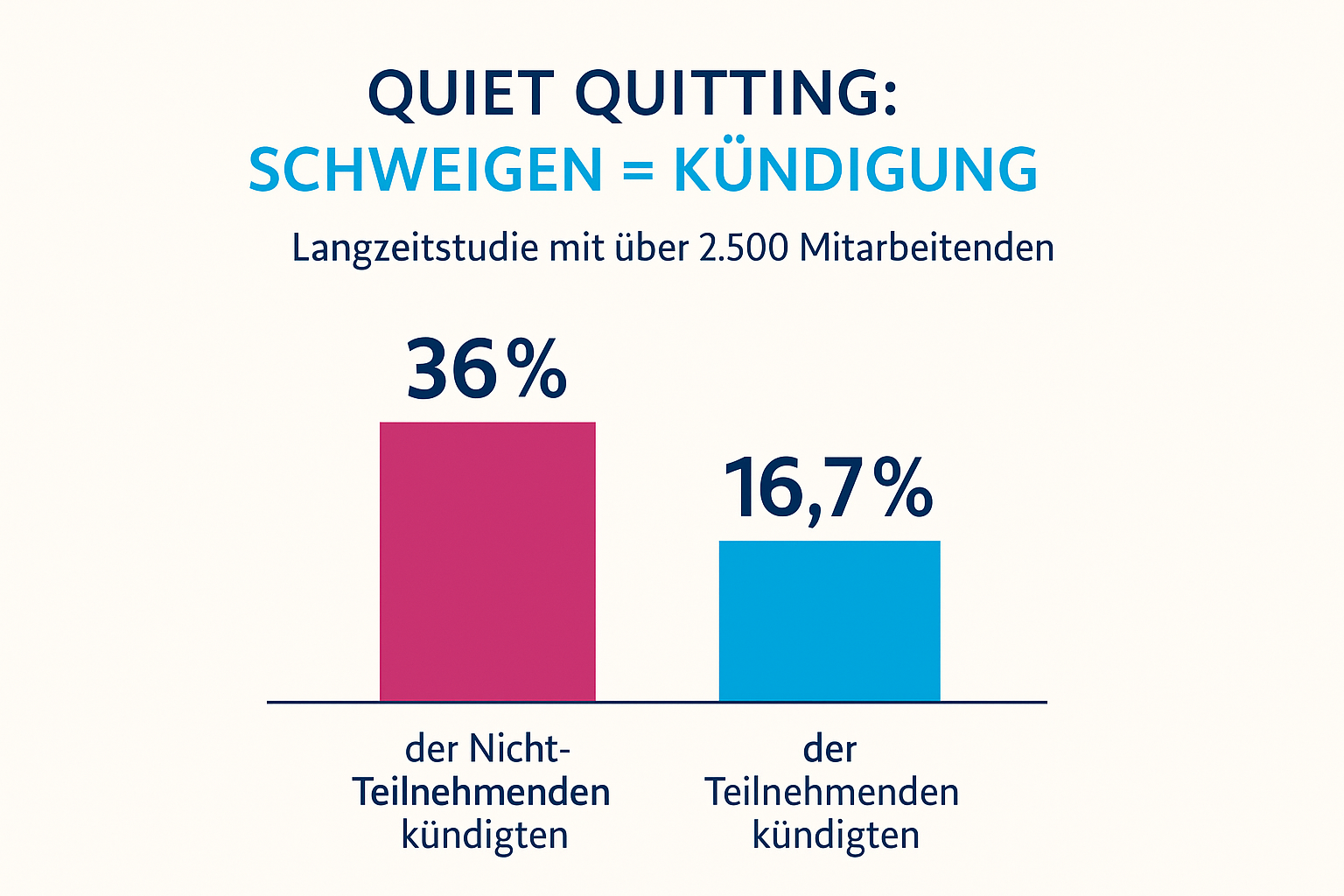
What if everyone had taken part? Would the results then be better or worse? Our exclusive long-term study with over 2,500 employees of a Swiss company provides a clear answer: the results would be worse. Employees who do not take part in surveys have often already resigned internally.
Our data shows an alarming picture:
- 36% of non-participants quit within two years.
- The termination rate among participants was only 16.7 %.
The risk of dismissal is therefore more than twice as high for silent employees. This phenomenon, also known as "quiet quitting", is a silent killer for employee retention.
Not every criticism is a dismissal signal
Not every critical voice is a signal for dismissal. On the contrary: constructive criticism shows that employees are still committed and open to change. It only becomes dangerous when they fall silent. Silent resignation is the clearest warning signal of an impending wave of redundancies - and our studies provide impressive proof of this.
💡 Infobox: Response rate - definition and calculation
Definition A low response rate to a survey means that only a few of the invited employees took part. At ValueQuest, we conduct full surveys. Not only individual groups are surveyed, but all employees across all hierarchical levels and teams.
Consequences of a low response rate A response rate that is too low makes results unreliable, unrepresentative and weakens the credibility of the study. This increases the risk of wrong strategic decisions that do not apply to entire departments or groups of employees.
Calculation The response rate [in percent] is calculated by dividing the number of returned questionnaires by the number of questionnaires sent out and multiplying by 100.
Example: If 80 out of 100 employees take part in a survey, the response rate is 80%. However, this can vary from team to team. If one team of 12 employees has a participation rate of 50 % and another team of 6 employees has a participation rate of 80 %, the weighted response rate for both teams is 60 %.
Participation and response rate
What is a good response rate?
For office workers, a good response rate is around 80 percent. In areas without direct computer access, it can be somewhat lower.
How can the response rate be increased?
In our experience, there are several factors that have an impact on the response rate. These include, above all, internal company communication, support from superiors, experience from previous surveys and trust in anonymity. But the timing and the current mood also have an impact. If employees are frustrated or overworked, they are less likely to take part.
What to do if the response rate is low?
Managers can take action in advance. They should make it clear that the survey is important, that employees' opinions will be heard and that concrete changes will result from it. If employees have the impression that nothing will happen anyway, they will be less willing to participate. On the other hand, those who are convinced that their voice counts will usually participate.

How to increase the response rate of your employee survey: 9 tips
A high response rate is not rocket science. With the right strategy and communication, you can significantly increase your employees' willingness to participate. Here are our best tips from the field:
Before the interview:
- Build trust through consistency: Show your employees that their feedback has consequences. If it is unclear whether something will happen after the survey, the motivation to participate decreases.
- Communicate early and transparently: Announce the survey at least two weeks in advance. Provide information about anonymity, duration, benefits and the next steps. Joint communication between management and HR creates trust.
- Explain the purpose of the survey: A short, clear introduction in the survey itself creates trust and shows employees why their opinion is important.
- Avoid sales language: Treat your employees like mature partners, not like children. Promotional language comes across as dubious and reduces the willingness to participate.
- Keep the questionnaire short and relevant: Less is more. Concentrate on the most important questions and formulate them clearly and comprehensibly.
- Choose the right time: Conduct surveys when they are relevant to your employees. Avoid busy periods such as the Christmas season in the retail trade.
After the interview:
- Give visible feedback: A brief thank you or interim results show appreciation and recognition.
- Share the results transparently: Disclose what came out of the survey. This creates transparency and increases the willingness to participate in the next survey. It is best to have the results presented by an external partner such as ValueQuest in order to increase legitimacy.
- Follow up with action: A survey is not an end in itself. If the results are not followed up with visible measures, you will lose the trust of your employees. Implement concrete steps and communicate transparently what results from the feedback.
Conclusion: Your response rate is a valuable early warning system
The response rate of your employee survey is far more than just a key figure for data quality. It is a crucial early warning signal for employee turnover and a lack of commitment. Companies that take the participation rate seriously and draw the right conclusions from it can proactively prevent dismissals, strengthen their feedback culture and build a committed workforce in the long term.
Article published on September 5, 2025
About Bruno Catellani

Inspired? Then share this post via your favorite platform.
Other articles that might interest you ...

AI in the Swiss Insurance Market: What Insurers Can Learn from the Results
October 1, 2026
Reading time: 4 min
Artificial intelligence is not universally accepted in the Swiss insurance market. As a study by ValueQuest shows, customers’ openness to AI depends heavily on how it is used.

AI in the Swiss Insurance Market: Between Acceptance and Skepticism
September 28, 2026
Reading time: 5 min
For many Swiss people, artificial intelligence has become an integral part of everyday life. However, the situation is different when it comes to insurance companies.

Top Employer: Raiffeisenbank Glarnerland Impresses with Strong Leadership
September 21, 2026
Reading time: 2 min
ValueQuest recently had the honor of presenting the “Excellence@Work Award” to Raiffeisenbank Glarnerland. We extend our heartfelt congratulations.
Top Swiss Employers: GastroSocial
September 9, 2026
Reading time: 3 min
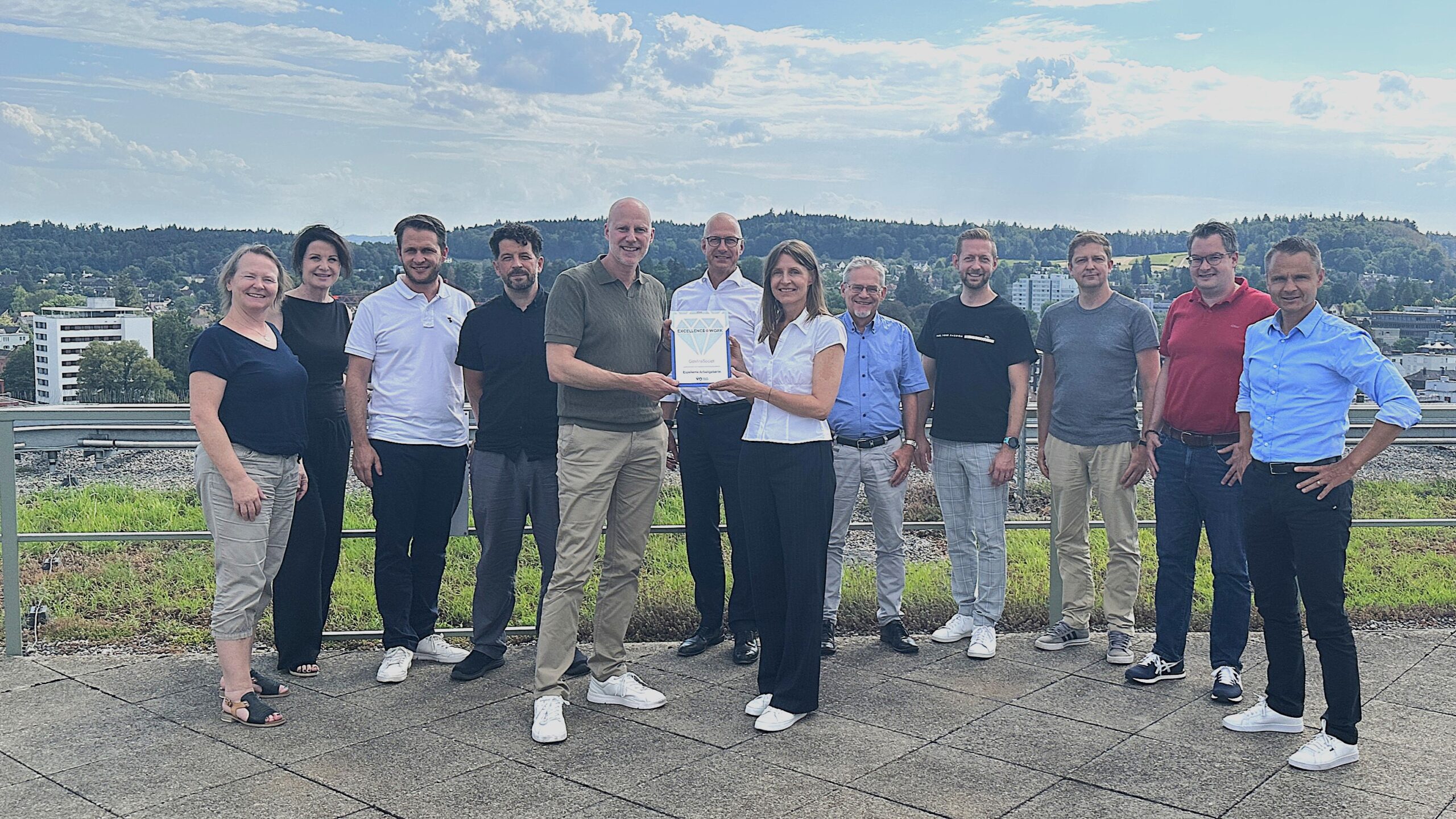
GastroSocial has received the 2026 Excellence@Work Award from ValueQuest. With a response rate of 96 percent, a motivation score of 84, and 87 percent of employees serving as brand ambassadors, the company demonstrates a strong employer culture.

Employee Survey: Raiffeisenbank Möhlin Achieves Excellent Results
August 31, 2026
Reading time: 3 min
Raiffeisenbank Möhlin is one of Switzerland's top employers and is receiving our Excellence@Work Award in recognition of this achievement. Congratulations!

Employee Surveys in Switzerland: Find Providers & Tools
August 30, 2026
Reading time: 6 min
Employee Survey in Switzerland: How Do You Find the Right Employee Survey Provider? What Really Matters When It Comes to Anonymity, Tools, Questionnaires, and Analysis.

360-Degree Feedback Questionnaire: Sample, Template, and Sample Questions
August 21, 2026
Reading time: 7 min
Table of Contents A 360-degree feedback process is only as good as its questionnaire. The questionnaire is at the heart of the entire process. It determines whether...

Employee Survey: The CAMPUS SURSEE Foundation Is Among Switzerland's Best Employers
August 5, 2026
Reading time: 2 min
ValueQuest honors particularly attractive employers in Switzerland with the Excellence@Work Award. We recently had the pleasure of presenting the award to the CAMPUS SURSEE Foundation.

Raiffeisenbank Regio Arbon, a Top Employer: Personal Responsibility as Part of a Strong Corporate Culture
July 7, 2026
Reading time: 2 min
ValueQuest honors particularly attractive employers in Switzerland with the Excellence@Work Award. We recently had the pleasure of presenting the award to Raiffeisenbank Regio Arbon.