Table of contents
One of the best-known and most widely used instruments for measuring employee engagement is the Q12 questionnaire developed by the American market research institute Gallup.
The Gallup report "State of the Global Workplace 2023" provides sobering figures: only 11% of Swiss employees show a high level of emotional attachment to their employer. A large majority—79%—do the bare minimum, and 10% have already mentally resigned.
But how well does the Gallup Q12 actually measure employee engagement in Switzerland? In this article, we will discuss the Gallup Q12 model and its scientific basis, compare it with other approaches, and analyze its relevance for employers in Switzerland. In doing so, we want to show how companies can effectively measure and increase employee engagement.
Employee engagement: Definition according to Gallup
What is employee engagement?
The term "employee engagement" is often used vaguely in German and equated with commitment, motivation, or personal engagement. In the English-language context, as used by Gallup, employee engagement is defined more precisely. It does not refer to voluntary extra work in the moral sense, but rather to the degree of emotional, cognitive, and psychological attachment that employees have to their work and their employer.
Gallup therefore understands employee engagement as a state in which employees not only do their work, but also feel intrinsically connected to it, take responsibility, and want to actively contribute.
Engagement is not a stable personality trait of individuals, but rather the result of a work environment that can be shaped. The decisive factor is whether employees find the conditions they need to use their strengths, receive recognition, see meaning in their work, and develop further. These conditions are precisely what the Gallup Employee Engagement Index Q12 focuses on.
Scientific background of the Q12 Engagement Index
The definition of employee engagement is linked to scientific research on engagement. One of the central theoretical perspectives was shaped by organizational psychologist William Kahn, who defined engagement as early as 1990 as "bringing the self into the work role." Kahn describes engagement as the simultaneous activation of several levels of work experience and distinguishes three dimensions:
- Cognitive engagement: mental focus and attention at work
- Emotional commitment: emotional attachment to the work and the company
- Physical engagement: the use of energy to perform work tasks
Employee engagement therefore does not describe a purely emotional or motivational state, but rather a holistic "involvement" in one's own work. The Gallup Employee Engagement Q12 questionnaire takes this understanding into account. It does not directly measure the subjective feeling of engagement, but rather assesses the working conditions under which cognitive, emotional, and physical engagement can develop.

Measuring engagement with the Gallup Q12
Over more than 30 years, the market research institute Gallup has surveyed more than 17 million employees worldwide and identified patterns that distinguish high-performing teams from less effective teams. The Gallup Q12 is a measurement tool developed and validated over decades for companies and scientists to measure employee engagement.
The Gallup Q12 consists of twelve concise statements about perceptions of work, which employees rate on a Likert scale.
The twelve questions of the Gallup Q12 engagement measurement are:
- I know what is expected of me at work.
- I have the materials and equipment I need to do my job properly.
- At work, I have the opportunity to do what I do best every day.
- Over the past seven days, I have received recognition or praise for good work.
- My supervisor or someone at work seems to be interested in me as a person.
- There is someone at work who encourages my development.
- At work, my opinions seem to count.
- The mission or purpose of my company makes me feel that my work is important.
- My colleagues or employees are determined to deliver high-quality work.
- I have a best friend at work.
- In the last six months, someone at work has talked to me about my progress.
- Last year, I had the opportunity to learn and grow at work.
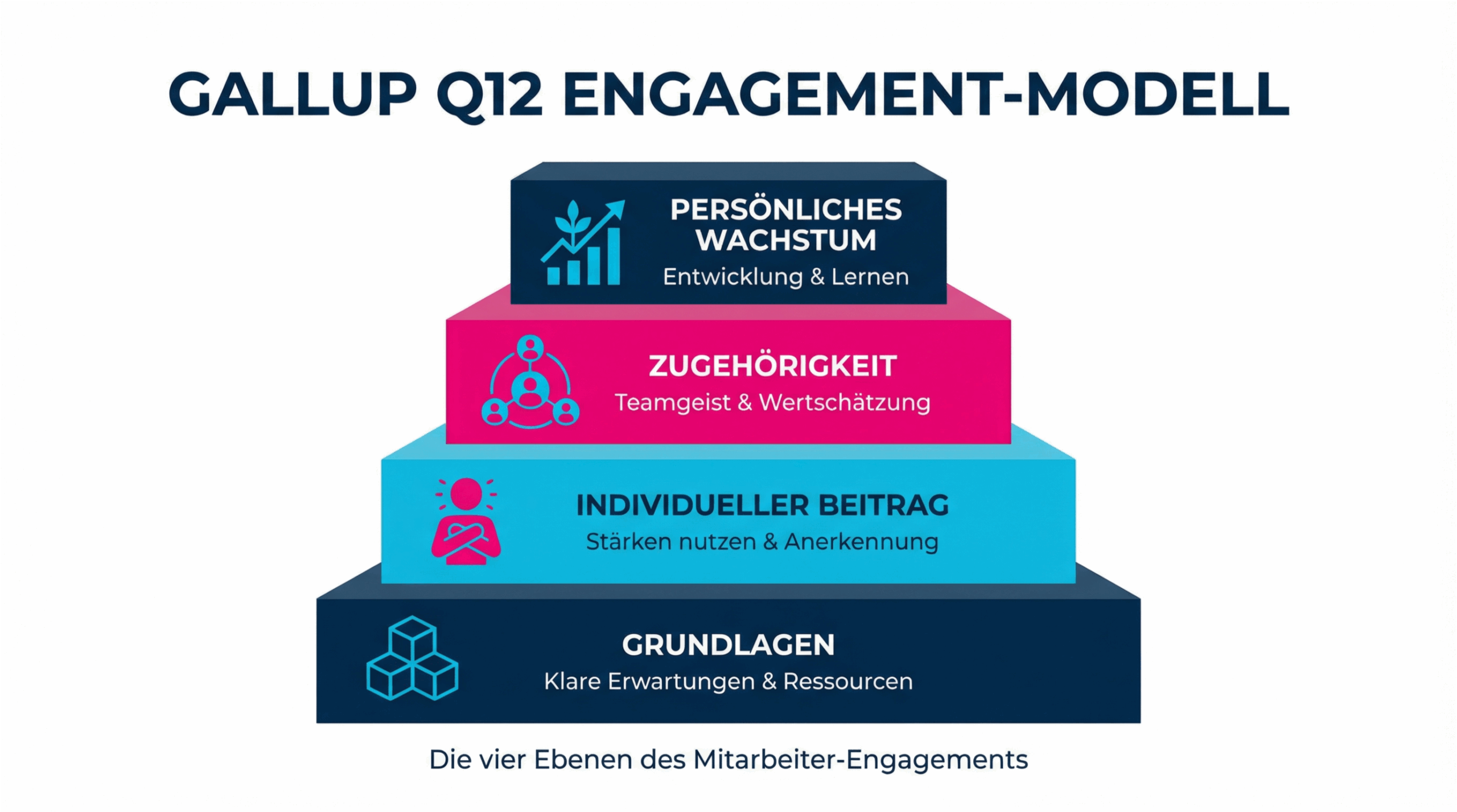
The Gallup Q12 questionnaire is based on a hierarchical measurement model. It implies that basic needs (such as clear expectations and the right resources) must be met (questions Q1 and Q2) before higher employee engagement can unfold at the level of each employee's individual contribution (Q3, Q4, Q5, and Q6), belonging (Q7, Q8, Q9, Q10) and personal growth (Q11, Q12) can develop. The hierarchical structure of the questionnaire model shows that employee engagement cannot be viewed in isolation. Rather, employee engagement is embedded in a context of basic security, appreciation, and development. An employee who does not know what is expected of them or does not have the right tools cannot possibly reach the higher levels of engagement, no matter how inspiring the company mission is.
Gallup deliberately kept the questions in Q12 simple and straightforward. However, the questions target profound psychological needs in the workplace. Gallup structures these needs into a hierarchy with four levels that build on each other:
| Pillar (Competence) | Description | Reference to the sense of coherence |
| 1. Realistic optimism | The ability to acknowledge difficulties but still believe firmly in a positive solution and in one's own competence. | Strengthens meaningfulness and manageability—core elements of resilience. |
| 2. Acceptance | The art of accepting unchangeable situations and not wasting energy fighting windmills. | Promotes comprehensibility (acknowledging reality) – essential for resilience. |
| 3. Solution orientation | Focusing on what can be done instead of dwelling on the problem. It's about taking proactive action. | The core of manageability – the basis of resilience. |
| 4. Leaving the victim role behind | Taking responsibility for one's own reactions and actions in order to regain control. | Strengthens manageability and meaningfulness—both of which are central to resilience. |
| 5. Social support | Consciously building and maintaining a network of colleagues, friends, and mentors as an emotional safety net. | A key resource for manageability – people with strong networks develop resilience more quickly. |
| 6. Planning for the future | Focusing on clear personal and professional goals that provide guidance and meaning even in difficult times. | The core of meaningfulness – without goals, resilience cannot develop. |
| 7. Self-reflection | Regularly examining your own thoughts, feelings, and behavior patterns in order to continuously learn and grow. | The core of comprehensibility – resilience arises from understanding one's own patterns. |
Measuring engagement with the Likert scale
The questions in the Gallup Engagement Index are rated by employees using a Likert scale. In practice, a five-point Likert scale is predominantly used:
- I completely disagree
- I tend to disagree
- partly partly
- I tend to agree
- I completely agree.
This form of measuring employee engagement allows subjective perceptions to be systematically recorded and compared across teams, organizational units, and time periods. The Gallup Q12 is therefore suitable for both one-time assessments and regular repeat surveys.
Calculation of the Gallup Q12 Engagement Index
The Gallup Engagement Index Q12 is evaluated in several stages. First, an average value is calculated for each of the twelve engagement questions. These individual values show how pronounced certain dimensions of engagement are, such as role clarity, recognition, belonging, or development opportunities. At this level, very specific areas for action can be identified.
In addition, an aggregate total score is often calculated across all twelve engagement questions. This Q12 total score serves as a compact engagement indicator and enables comparisons between teams, locations, or organizational units. The Gallup Engagement Index Q12 is particularly valuable for benchmarking, as Gallup has access to a very large international comparison database. However, it is important to note that high average values should not obscure the fact that individual topics may still have room for improvement.
Interpretation of employee engagement
When it comes to leadership and organizational development, it is not only the level of employee engagement that is crucial, but also where it comes from or where it is blocked.
Since Gallup does not disclose the exact thresholds for assigning employees to engagement categories, many companies work with practical interpretation grids based on experience, benchmarks, and empirical plausibility.
| Commitment category | Typical value range | characteristic |
| Dedicated employees | approx. from 4:00 a.m. | High level of agreement on most Q12 questions. Emotional attachment, initiative, taking responsibility. |
| Uncommitted employees | approx. 3.20 to 3.99 | Tasks are performed correctly, but with little emotional identification. |
| Actively disengaged employees | usually below 3.20 | Inner distance, frustration, potentially negative impact on team and performance. |
Here, too, the following applies: Individual low scores on key issues (e.g., recognition, development, or clear expectations) can be more important than the overall score for employee engagement.
Gallup Q12: Advantages and disadvantages of the questionnaire
Advantages of the Gallup Q12 questionnaire
The Gallup Engagement Measurement is simple and easy to use.
The popularity of the Gallup Q12 is no coincidence. The Gallup Q12 is very simple, easy to understand, and easy to use. The results provide managers with clear starting points for further developing their leadership style and corporate culture. Another advantage is efficiency: it only takes employees a few minutes to answer the twelve questions, which increases participation rates and improves data quality.
The connection between employee productivity and employee engagement
Gallup has demonstrated in numerous analyses and studies that high engagement scores correlate significantly with important business metrics such as higher employee productivity, profitability, customer satisfaction, and lower employee turnover.
Gallup's huge database also enables comprehensive benchmarking across industries and regions.
Disadvantages of the Gallup Q12 questionnaire
Significant simplification of employee engagement
Critics argue that the simplicity of the Gallup Q12 Engagement Index is also its main weakness. They argue that the Gallup Q12 greatly reduces the complexity of employee engagement and only provides a limited picture of complex psychological, organizational, and cultural relationships.
Furthermore, there is debate in academic literature as to whether the Gallup Q12 Engagement Index actually measures employee engagement in the narrower sense or rather reflects job satisfaction and positive working conditions. Employee engagement is understood as an active, energetic, and emotionally involved state, while employee satisfaction describes a more evaluative, comparatively passive attitude. This conceptual distinction between employee engagement and satisfaction is significant, especially for research and strategic conclusions. Critics see a danger here that high Gallup Q12 scores indicate that employees find their work enjoyable without necessarily being above-average in terms of engagement, initiative, or intrinsic involvement.
Not very suitable for Switzerland
The underlying human needs for appreciation, growth, and belonging are universal. But can the Gallup Q12 also measure engagement in Switzerland? The question about the "best friend at work" (Q10) is particularly controversial. While Gallup interprets this question as an indicator of trust, social connectedness, and informal support, it causes irritation in many cultural contexts, especially in Switzerland. The concept of a "best friend" is often perceived as too private, emotional, or even normative in Switzerland. Swiss work cultures are traditionally characterized by professional distance, restraint, and a clear separation between work and private life. Close collegiality or mutual reliability are certainly valued, but not necessarily understood or referred to as friendship. Accordingly, there is a risk that the question measures less the actual extent of social support and more reflects cultural communication styles or individual interpretations of closeness.
Too much focus on the manager
Another key point of criticism concerns the Q12 Engagement Index's strong focus on the role of direct managers. Leadership is important, but it is not the only lever! It is well documented that supervisors have a significant influence on the experience of work. However, critics complain that organizational conditions such as structures, processes, workload, compensation systems, and corporate culture are not given enough consideration. Factors that lie outside the direct sphere of influence of individual managers could thus be pushed into the background, even though they are highly relevant to employee engagement and well-being.
Employee engagement is a complex phenomenon. The Gallup Q12 provides a pragmatic and effective questionnaire for measuring and improving it. By focusing on fundamental, manageable elements of the work environment, it gives managers a clear tool for creating a culture of engagement.
Post published on January 17, 2026
About Dr. Kathrin Neumüller

Dr. oec. HSG Kathrin Neumüller is Co-Managing Director at ValueQuest and an expert in employee inspiration and empowerment. She also teaches strategic management in the MBA program at the ZHAW. She holds a doctorate from the University of St. Gallen (HSG) and studied at the University of Cambridge. Learn more about Kathrin
Inspired? Then share this post via your favorite platform.
Other articles that might interest you ...

AI in the Swiss Insurance Market: What Insurers Can Learn from the Results
October 1, 2026
Reading time: 4 min
Artificial intelligence is not universally accepted in the Swiss insurance market. As a study by ValueQuest shows, customers’ openness to AI depends heavily on how it is used.

AI in the Swiss Insurance Market: Between Acceptance and Skepticism
September 28, 2026
Reading time: 5 min
For many Swiss people, artificial intelligence has become an integral part of everyday life. However, the situation is different when it comes to insurance companies.

Top Employer: Raiffeisenbank Glarnerland Impresses with Strong Leadership
September 21, 2026
Reading time: 2 min
ValueQuest recently had the honor of presenting the “Excellence@Work Award” to Raiffeisenbank Glarnerland. We extend our heartfelt congratulations.
Top Swiss Employers: GastroSocial
September 9, 2026
Reading time: 3 min
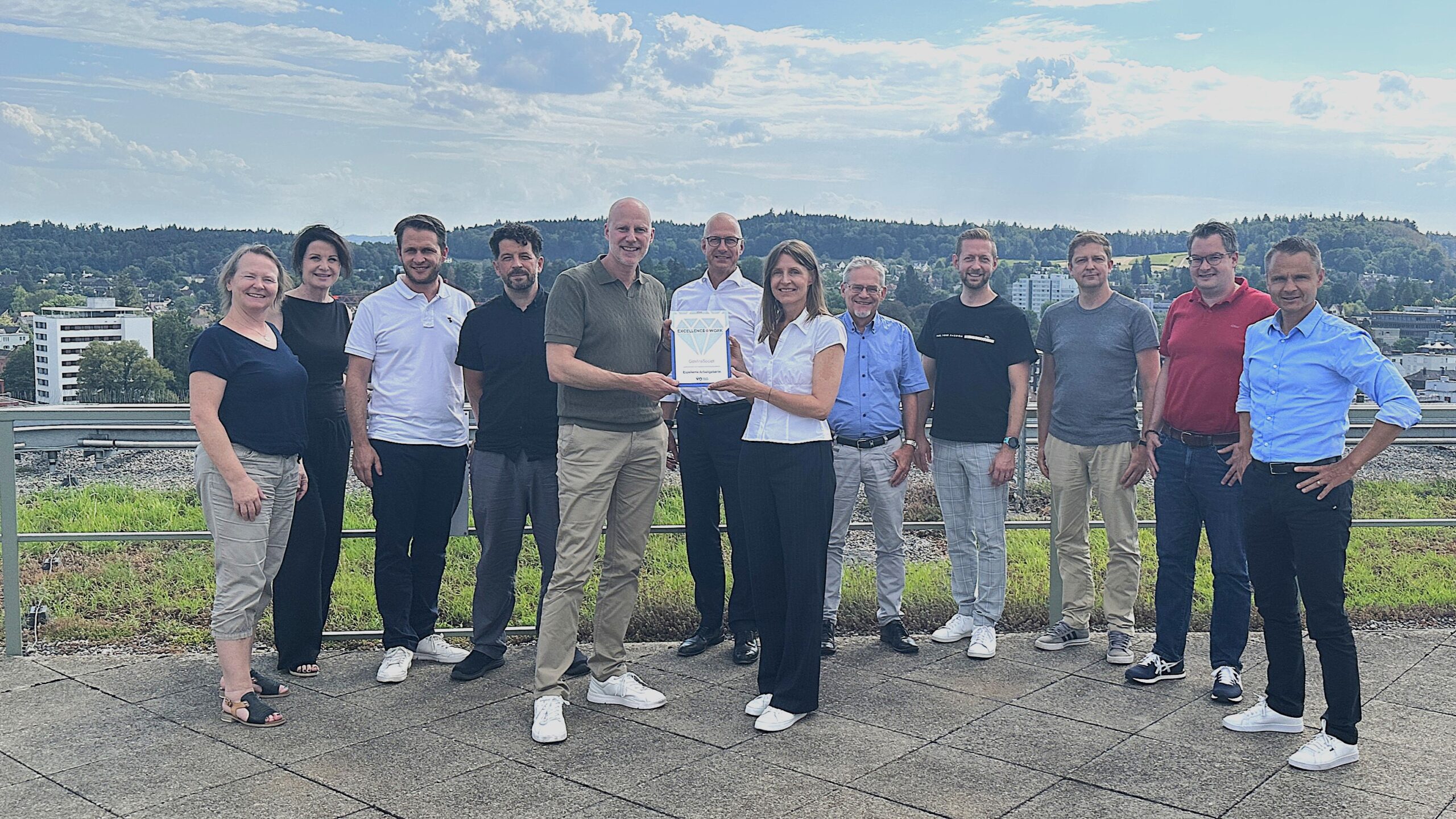
GastroSocial has received the 2026 Excellence@Work Award from ValueQuest. With a response rate of 96 percent, a motivation score of 84, and 87 percent of employees serving as brand ambassadors, the company demonstrates a strong employer culture.

Employee Survey: Raiffeisenbank Möhlin Achieves Excellent Results
August 31, 2026
Reading time: 3 min
Raiffeisenbank Möhlin is one of Switzerland's top employers and is receiving our Excellence@Work Award in recognition of this achievement. Congratulations!

Employee Surveys in Switzerland: Find Providers & Tools
August 30, 2026
Reading time: 6 min
Employee Survey in Switzerland: How Do You Find the Right Employee Survey Provider? What Really Matters When It Comes to Anonymity, Tools, Questionnaires, and Analysis.

360-Degree Feedback Questionnaire: Sample, Template, and Sample Questions
August 21, 2026
Reading time: 7 min
Table of Contents A 360-degree feedback process is only as good as its questionnaire. The questionnaire is at the heart of the entire process. It determines whether...

Employee Survey: The CAMPUS SURSEE Foundation Is Among Switzerland's Best Employers
August 5, 2026
Reading time: 2 min
ValueQuest honors particularly attractive employers in Switzerland with the Excellence@Work Award. We recently had the pleasure of presenting the award to the CAMPUS SURSEE Foundation.
Raiffeisenbank Regio Arbon, a Top Employer: Personal Responsibility as Part of a Strong Corporate Culture
July 7, 2026
Reading time: 2 min
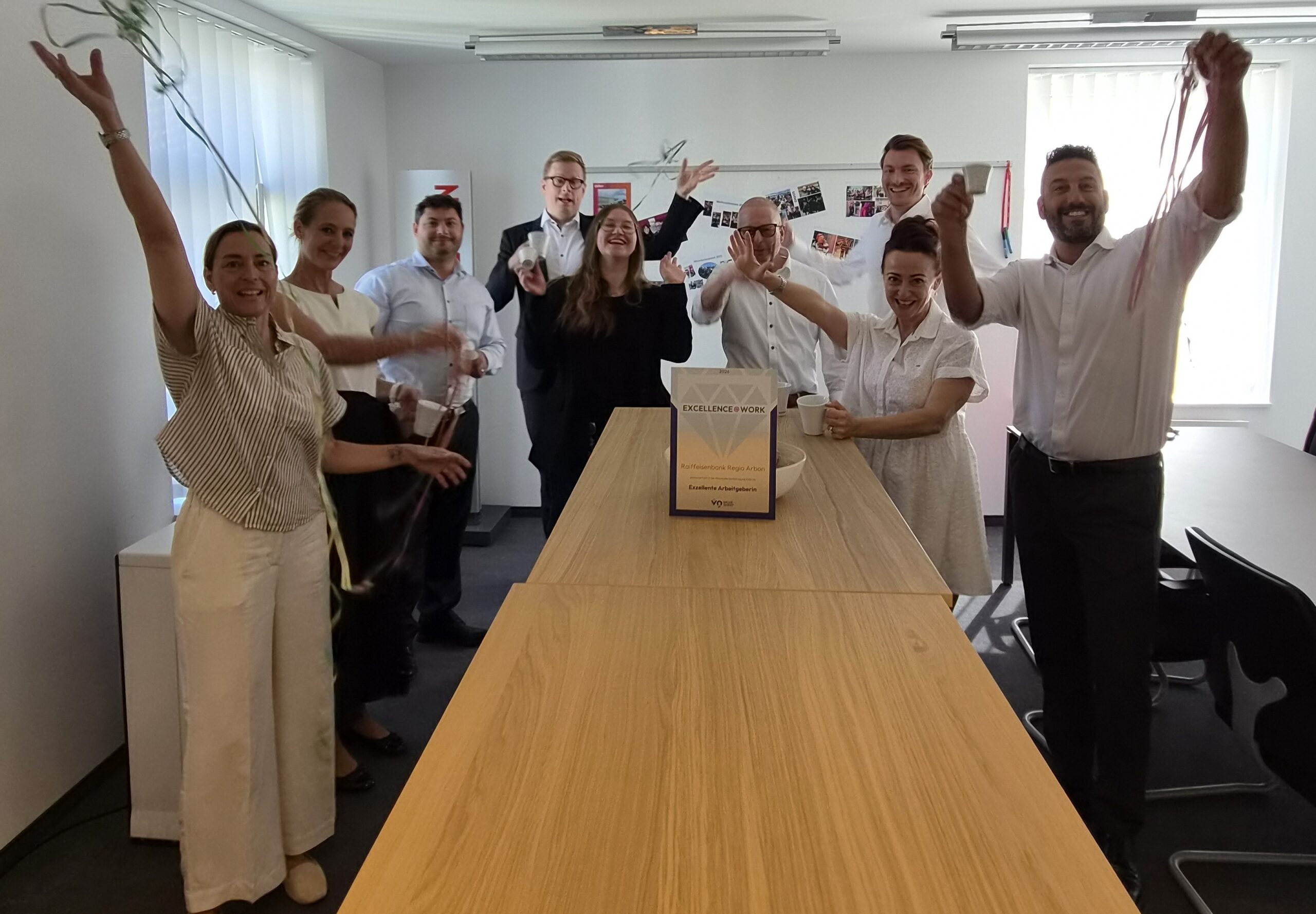
ValueQuest honors particularly attractive employers in Switzerland with the Excellence@Work Award. We recently had the pleasure of presenting the award to Raiffeisenbank Regio Arbon.